Showing posts with label African American History. Show all posts

Tuesday, February 1, 2022

Tennessee State Library & Archives to Host Meharry Medical College Exhibit for Black History Month


During Black History Month, Meharry Medical College, one of the nation’s oldest and largest Historically Black Colleges and Universities dedicated to educating physicians, dentists, researchers and health policy experts, will display artifacts from its rich and storied history at the Tennessee State Library & Archives. 

“Meharry Medical College is an outstanding medical training facility, whose graduates are making a positive impact on public health in Middle Tennessee and across the country,” said Secretary of State Tre Hargett. “We are honored to host Meharry’s Black History Month exhibit at the Library & Archives.” 

Founded in 1876 as the Meharry Medical Department of Central Tennessee College and independently chartered in 1915, Meharry was the first medical school in the South for African Americans. Today, Meharry offers advanced degrees in medicine, dentistry, public health and biomedical data sciences. It is also home to the Center for Health Policy at Meharry. Meharry is a premier medical research facility and has been rated as one of the nation’s top producers of primary care physicians and Ph.Ds. in biomedical sciences. 

“The evolution and history of Meharry Medical College is phenomenal to read; however, its compelling story is best documented in the remarkable collection of photographs that memorialize the spirit of Meharry,” said Sandra Parham, Meharry Medical College Library & Archives Executive Director. “Our goal is to expose students outside of Meharry to its rich history and sustained future, recognizing that almost 150 years later, Meharry continues devotion to its motto: Dedicated to the worship of God through service to man.” 

To preserve Tennessee's history for current and future generations, The Tennessee State Library & Archives, a division of the Department of State, collects and protects books, records and other documents of historical and reference value, focusing on items about Tennessee and Tennesseans. 

The Library & Archives is home to many irreplaceable historical documents, including Tennessee's three constitutions, letters from Tennessee's three presidents, Civil War diaries, records from 55 former Tennessee governors, more than a million photographs, 5,000 maps, the state's largest collection of microfilm negatives, a comprehensive collection of Tennessee newspapers dating back to 1791 and original records of the State of Franklin. 

“We were excited to work with Meharry Medical College to curate this exhibit and are looking forward to sharing it with new visitors to the Library & Archives and our returning patrons,” said Chuck Sherrill, Tennessee State Librarian and Archivist. 

The Library & Archives interactive exhibit lobby, featuring displays highlighting the state's most precious historical documents, is open to the public Monday through Saturday, from 8 a.m. to 4:30 p.m. CT. The library, microfilm and manuscripts reading rooms are open for research Tuesday through Saturday, from 8 a.m. to 4:30 p.m. CT. 

The Library & Archives is located at 1001 Rep. John Lewis Way North on the northeast corner of Bicentennial Capitol Mall State Park, across from the Tennessee State Museum. Parking is available for guests in the Library & Archives garage on Jackson Street/Junior Gilliam Way. 

As part of a city-wide exhibition, Meharry Medical College is also hosting Black History Month exhibits at Fisk University’s John Hope and Aurelia E. Franklin Library, Belmont University’s Lila D. Bunch Library and the Nashville Public Library’s Main Branch downtown. 

For more information about the Meharry Medical College Black History Month exhibit project, contact Executive Director Sandra Parham at 615-327-5770 or sparham@mmc.edu. For more information about the Library & Archives, call 615-741-2764, email ask@tsla.libanswers.com or visit sos.tn.gov/tsla/plan-your-visit. 


The Tennessee State Library & Archives is a division of the Office of Tennessee Secretary of State Tre Hargett

Monday, August 24, 2020

The Ardent Gardeners Association

By Allison Griffey

The Ardent Gardeners Association was organized in 1951 by twenty-three women in Nashville following the tradition of garden clubs formed in the late forties after World War II. Two teachers, Blanche Ennix and Ruth McAlpin, spearheaded the effort. Inspired by their enthusiasm and commitment to the new organization, Dr. William H. Grant, the husband of charter member, Ruth Grant, suggested the name the Ardent Gardeners.


The Ardent Gardeners’ first flower show on July 11, 1952, at the Hadley Park Community Center (left to right): Henri Dixon, Rhea Tarleton, Ruth McAlpin, Ruth Grant, Dora McClelland, Hazel Burley, Rachel Lindsay, Arthurine Welch, Lillian Thomas, Mary Walker, Carrie Denney, Martha Allen, Mattie Claiborne, Kathleen Lawrence, Mattie Flowers, Alberta Bontemps, Elizabeth Petway Lowe, Eva Nash, Blanche Ennix, and Thelma Treherne.
Ardent Gardeners Association Records, 1951-1998, Box 3, Folder 7.
https://sos.tn.gov/products/tsla/ardent-gardeners-association-records-1951-1998


Library decorations at the Ardent Gardeners Association’s “A Holiday House” event at the home of Elise Frazier, undated.
Ardent Gardeners Association Records, 1951-1998, Box 3, Folder 2.
https://sos.tn.gov/products/tsla/ardent-gardeners-association-records-1951-1998


Club members dedicated themselves to learning about growing and arranging plants throughout the year, especially flowers. They organized workshops and clinics to learn about flower arranging and gardening from industry professionals. On July 11, 1952, the Ardent Gardeners hosted their first flower show at the Hadley Park Community Center. Following the success of their flower shows, the club presented a winter event called “A Holiday House” on December 11, 1955, at the home of Ruth Grant. The group continued to hold this holiday event on and off until 1974 when they discontinued the tradition because local florists started holding similar events.


Ardent Gardeners picnic in Ruth Grant’s backyard, undated.
Ardent Gardeners Association Records, 1951-1998, Box 3, Folder 2.
https://sos.tn.gov/products/tsla/ardent-gardeners-association-records-1951-1998


Zenobia Beck at her home garden, undated.
Ardent Gardeners Association Records, 1951-1998, Box 3, Folder 4.
https://sos.tn.gov/products/tsla/ardent-gardeners-association-records-1951-1998


Outside of club meetings and shows, the Ardent Gardeners also served their community. Members helped the Metro Beautification Commission clear out the former Maxwell House lot on Fourth and Church Streets to create “The World’s First Instant Park” in 1964. They also decorated the Hubbard Hospital Medical College in partnership with other garden clubs. In 1984, they dedicated the atrium garden fountain at Meharry Medical College to their first president, Ruth McAlpin. They named the Meharry atrium garden “The Doris Campbell Busby Memorial Garden” in 1986 after one of their most devoted leaders. In 1991, the Ardent Gardeners celebrated their fortieth anniversary with a luncheon at the Pineapple Room of Cheekwood Gardens.


Alberta Bontemps demonstrates special arrangements required by some containers, undated.
Ardent Gardeners Association Records, 1951-1998, Box 3, Folder 5.
https://sos.tn.gov/products/tsla/ardent-gardeners-association-records-1951-1998


The Ardent Gardeners’ fortieth-anniversary luncheon at Cheekwood on April 7, 1991 (front row left to right): Lillian Thomas, Mattie Johnson, Delores Crump, Ruth Grant, Isabel Watkins, Gretchen Payne, Carrie Denney, Alberta Bontemps, Elise Frazier, Blanche Ennix, Willie Mae Martin, Mattie Flowers (back row left to right): Zenobia Beck, Eugenia McGinnis, Rachel Lindsay, Kathleen Lawrence, Tyree Miller, Corinne Schuster, Alice Archer, Hazel Burley, Dora McClellan, Helena Perry, Jayme Williams, Patsy Petway.
Ardent Gardeners Association Records, 1951-1998, Box 3, Folder 7.
https://sos.tn.gov/products/tsla/ardent-gardeners-association-records-1951-1998


The Library and Archives holds the Ardent Gardeners’ records from 1951 to 1998. The association remains active in the Nashville community to this day. This blog post is a summary of a document found in the collection called “History of the Ardent Gardeners Club of Nashville, Tennessee” written by charter member, Dolores Crump. 

Readers and researchers who want to learn more are encouraged to contact the Library and Archives to schedule an appointment to view the collection. 


The Tennessee State Library and Archives is a division of the Office of Tennessee Secretary of State Tre Hargett

Monday, January 6, 2020

New Story Map: Mapping the Destruction of Tennessee's African American Neighborhoods

By Zach Keith

The Tennessee State Library and Archives is proud to present a new project using the GIS story mapping tool. Story maps allow for data, documents, and narrative to be presented along with geo-referenced maps to show the spatial evolution of a historical theme.

The "Mapping the Destruction of Tennessee's African American Neighborhoods" story map project details the often destructive impact of urban renewal and interstate projects of the mid-20th century on Tennessee's African American communities.

The mid-20th century building of the interstate highway system, public housing projects, and so-called "urban renewal" programs are commonly viewed as crucial elements in the modernization of America. The plans, however, produced unequal benefits for Tennessee's citizenry. For those whose neighborhoods were unaffected, statistically more likely to be white and wealthy, cities became more attractive and travel easier. For those who lost homes and businesses, more likely to be poor and African American, such projects entailed a severe disruption or even destruction of their communities and made it more difficult to accumulate property and wealth. The effects of these projects persist today.


Before and After: These two images show the razing of Capitol Hill from similar vantage points.


The project combines GIS software and primary sources. Overlaying historical maps onto present-day maps created an interactive exhibit whereby users can visualize the direct effects of these public works projects in cities across Tennessee, revealing how these neighborhoods looked before their erasure from the landscape.

Visit "Mapping the Destruction of Tennessee's African American Neighborhoods" to learn more.


The Tennessee State Library and Archives is a division of the Office of Tennessee Secretary of State Tre Hargett

Wednesday, June 19, 2019

“Bravery, Tenacity, and Deeds of Noble Daring”: The 13th United States Colored Troops in the Battle of Nashville

By Andrew McMahan

The Civil War brought about several drastic changes to the United States. Among these was the entry of tens of thousands of African Americans into the armed services, an act most Americans viewed as a right reserved for white citizens. Initially, the Union did not recruit black soldiers. However, enslaved people in the South closely followed the movements of U.S. troops, escaping and running to the safety of the Union lines whenever possible. Army officers hired many of these refugees as laborers and cooks. Despite the many thousands of African Americans eager to enlist, the Union armed forces were not permitted to employ black troops until Abraham Lincoln issued the final version of the Emancipation Proclamation on January 1, 1863. In response to an influx of new recruits, Secretary of War Edwin M. Stanton established the Bureau of Colored Troops (BCT) in May 1863 in order to centralize enlistment of African American soldiers. Although regiments formed under the BCT were comprised of black troops, the Union Army placed only white officers in command. Unlike other volunteer regiments, these did not incorporate the name of the states in which they were formed. Instead, they were designated United States Colored Troops (USCT), showing they were under federal rather than state authority.


This engraving shows African American recruits boarding a troop train bound for Murfreesboro, TN. Print and Broadside Collection, Tennessee State Library and Archives (TSLA).


The Union Army raised several USCT regiments in Tennessee. Organization of the 13th USCT began in Murfreesboro in July 1863. The brave men that made up this regiment were primarily laborers from Clarksville, Gallatin, Murfreesboro, and other areas in Middle Tennessee. These men were shortly sent to Nashville and formed the core of the 13th USCT. Colonel John A. Hottenstein was the regiment’s commanding officer.

Union officers regularly assigned USCT units to construction, garrison, and guard duties in order to free up white regiments for combat operations. Some white officers believed that African American troops were unfit for combat and would run when given the chance. As a result, the 13th USCT was primarily assigned to building and guarding the Nashville & Northwestern Railroad. By October 19, 1863, the regiment was positioned some thirty miles west of Nashville, guarding the Nashville & Northwestern. Evidently, the regiment was not fully organized by this time. Lieutenant Colonel Theodore Trauernicht stated he did not have enough men to provide laborers and guards for the railroad. Furthermore, he claimed their limited numbers prevented them from drilling and improving discipline because all of the men were busy as either laborers or guards. Trauernicht expressed concern for his men and stated that in the event of capture he was unsure whether Confederate forces would recognize the troops as soldiers of the United States or hang them as spies. He claimed all of these problems would be solved by having a full complement of men.

Union forces completed construction work on a portion of the Nashville & Northwestern in May 1864, and the regiment continued guarding the railroad until November 30. Elements of the regiment did conduct limited military operations during this time. For instance, in late August 1864, G Company, under the command of Captain Andrew Jacobs, set out on a scouting mission west of the Tennessee River. They marched 40 miles to Huntingdon, enduring summer heat and fatigue. On August 30, they came under sudden attack by a group of Confederate guerillas commanded by an individual Captain Jacobs identified as “Petty John.” The soldiers of G Company maintained their discipline and put up a determined fight, losing one man killed and a sergeant severely wounded. “Petty John” was wounded but escaped capture.

As of November 1864, the 13th had not participated in any major actions, aside from isolated skirmishes. Due to the unfounded opinions regarding African American troops in combat, the 13th USCT spent months on guard duty on the Nashville & Northwestern. However, Confederate General John Bell Hood’s campaign to retake Nashville in late 1864 changed this. In response to the Army of Tennessee’s advance, the companies of the 13th USCT assembled in Waverly on November 30 and departed for Nashville the next day. The regiment arrived in the city on the evening of December 7. Between December 7th and 13th, the men constructed rifle pits and other fortifications in anticipation of the Army of Tennessee’s assault on the city.

On December 11, Colonel Hottenstein and two hundred men scouted ahead of the Union positions in order to determine if the Army of Tennessee was to their front. The colonel and his troops applied pressure to the rebel pickets, driving them back to their main line. Finding that the Confederates had indeed arrived in force, the 13th withdrew to the Union positions. On December 13 the entirety of the 2nd Colored Brigade, commended by Colonel Charles R. Thompson, conducted a reconnaissance east of the Nashville & Chattanooga Railroad. The 13th regiment deployed as skirmishers, with the 12th and 100th in reserve. Once again, the 13th encountered the Confederate pickets and pushed them back toward their main line. The brigade faced substantial resistance on the property owned by a Mr. Rains. They remained there under heavy fire for some time, withdrawing just before dark. The 13th USCT lost one man killed and four wounded.

Evidently, the threat of Hood’s large Confederate force poised to attack Nashville prompted Union commanders to reconsider their stance on the combat capability of African American troops. On December 15, the 13th USCT along with the rest of the 2nd Colored Brigade were ordered to move into position for an assault on the Confederate line between the railroad and Nolensville Pike. The brigade quickly took the rebel earthworks directly ahead. However, the Confederates had expected them to attack this fortification and positioned their artillery in order to fire upon the USCT brigade once it captured the earthworks. Although the artillery fire was heavy, the earthworks provided sufficient shelter for the men of the 13th and other USCT regiments. They maintained this position for the remainder of the day, keeping up a steady exchange of fire with enemy skirmishers. The 20th Indiana Battery arrived to provide artillery support for the USCT men, and forced the Confederates to pull their cannons back.

On the morning of the 16th, the brigade commander sent skirmishers forward and discovered that the Confederates had abandoned their rifle pits and withdrawn to a new line. Colonel Thompson received orders to take his 2nd Colored Brigade and connect with General Thomas J. Wood’s 4th Corps. The 13th USCT, along with the 12th and 100th USCT, arrived at the intended position without taking any losses, though Confederate artillery on Overton’s Hill (also known as Peach Orchard Hill) did fire at the regiments. Upon arrival, General Wood informed Thompson that he was about to attack the enemy positions on Overton’s Hill, and requested that the three USCT regiments support his left flank. Overton’s Hill was heavily defended by Confederate infantry and artillery, making it a difficult position to take.

Overton's Hill can be seen in the bottom right corner of the map. TSLA Map Collection, Map 104.


At 3:00 pm, the Union troops of the 4th Corps and 2nd Colored Brigade began their daring attack. Thompson deployed his brigade in two lines, placing the 100th and 12th USCT in front and the 13th in support. The 12th encountered a dense thicket which slowed their advance, and the 100th came upon several fallen trees that broke up their formation. During this advance, the Union troops faced punishing fire from the Confederate soldiers on the hill. The 12th and the left portion of the 100th passed to the left of the Confederate fortifications, unable to face the line as the rebels had constructed it at a sharp angle. As a result, these two regiments suffered fire from both the side and the rear. Unable to turn the formation and face the enemy head-on, Thompson ordered the 12th to move off and take shelter behind another small hill in order to regroup and reform. Meanwhile, the rest of the 100th USCT continued advancing with the 4th Corps, but they were repulsed by the Confederates.

The 13th USCT pushed past the first line of the 2nd Brigade, weathering the withering fire laid down by the Confederates. Colonel Hottenstein remarked that he felt seeing the first line of Union troops lying down and taking cover from the rebel fire would negatively affect the courage of his relatively raw regiment. Although many of his men had been involved in skirmishes, the 13th USCT had yet to participate in such a deadly fight. However, the men of the 13th bravely pressed on. The regiment relentlessly advanced up the hill, despite taking heavy casualties, and actually stormed the Confederate earthworks. Unfortunately, the white Union troops to their right had already fallen back by this point. With no support, the 13th USCT had no choice but to pull back to their previous position. Although they did not take the hill, the Confederates were forced to withdraw after their line was breached elsewhere. Unable to take the city, the Army of Tennessee retreated from Nashville.

The attack on Overton’s Hill cost the 13th USCT dearly. The regiment went into battle that morning with 556 men and 20 officers. During the attack, they lost 4 officers and 55 enlisted men killed, and 4 officers and 165 enlisted men wounded. In total, the regiment lost 8 officers and 220 men during the 30 minute fight. Although the troops of the 13th USCT did not take the hill, they performed heroically and won the admiration of their superior officers and fellow soldiers. Colonel Hottenstein said of his men, “. . . after a protracted struggle they had to fall back, not for the want of courage or discipline, but because it was impossible to drive the enemy from his works by a direct assault.” He also commended the officers and enlisted men for their bravery, and specifically mentioned Sergeants James Wilson and Charles Rankin, who “. . . both displayed the greatest gallantry possible in carrying the colors, and sealed their devotion to them with their lives.” In engagements such as the Battle of Nashville, the regiments of the USCT proved themselves to their white counterparts and disproved the negative assumptions about the abilities of black soldiers. Many of these men escaped from bondage and enlisted, often without having ever handled a weapon, in order to end the practice of slavery once and for all in the United States. These soldiers may have been born into slavery, but they fought, and in many cases died, as free men.

Colonel Thompson recalled in his report, “These troops were here for the first time under such a fire as veterans dread, and yet, side by side with the veterans of Stone’s [sic] River, Missionary Ridge, and Atlanta, they assaulted probably the strongest works on the entire line, and, though not successful, they vied with the old warriors in bravery, tenacity, and deeds of noble daring.”


Sergeant Charles Rankin Service Record, Compiled Military Service Records of Volunteer Union Soldiers Who Served with the U. S. Colored Troops, MF 1742, Roll 104, TSLA.


Sergeant James Wilson Service Record, Compiled Military Service Records of Volunteer Union Soldiers Who Served with the U. S. Colored Troops, MF 1742, Roll 108, TSLA.


SELECTED BIBLIOGRAPHY:

The War of the Rebellion: A Compilation of the Official Records of the Union and Confederate Armies, Series I, Vol. 45.

Luke, Bob and John David Smith. Soldiering for Freedom: How the Union Army Recruited, Trained, and Deployed the U.S. Colored Troops. Baltimore: John Hopkins University Press, 2014.


The Tennessee State Library and Archives is a division of the Office of Tennessee Secretary of State Tre Hargett

Wednesday, April 4, 2018

MLK50: Remembering Martin Luther King, Jr.

Former Rep. Tommie F. Brown (D-Chattanooga) hosted a Black History Month program before the 104th Tennessee General Assembly Feb. 23, 2005, to honor the many contributions made by African-American members.

Christian Suttles recited a portion of Dr. Martin Luther King, Jr.’s “I Have A Dream…” speech by memory. King originally delivered his famous speech Aug. 28, 1963, during the March on Washington.


Dr. King was assassinated on the balcony outside his room at the Lorraine Motel in Memphis April 4, 1968. The motel is now the home of the National Civil Rights Museum, which is honoring the 50th anniversary of his death.

Video Courtesy: Tennessee General Assembly. Audio of this message is also available from the Legislative History Unit of the Tennessee State Library and Archives.


The State Library and Archives is a division of the Tennessee Department of State and Tre Hargett, Secretary of State

Tuesday, February 27, 2018

African American music traditions recorded in the Tennessee Virtual Archive

By Heather Adkins

Music traditions are fundamental to record-keeping in African-American communities. Profoundly unique, these traditions take the shape of storytelling and shared experience across one of the largest cultural populations in the United States. They are often characterized by the use of polyrhythms and rhyme and are passed from generation to generation.

Oak Grove Church of Christ Gospel Group, Chester County, July 20, 1980.
Tennessee State Parks Folklife Project, 1979-1984.
Image online: http://teva.contentdm.oclc.org/cdm/compoundobject/collection/p15138coll21/id/826/rec/104


Excerpt from Andrew Jones’ interview, relating a story about his Model T Ford, recorded July 14, 1981.
Tennessee State Parks Folklife Project, 1979-1984.


One such tradition is the “toast.” A toast is performed narrative poetry. Similar to tall tales and ballads, toasts celebrate heroic deeds. The tradition is mostly performed by men, and improvisation of stories is highly valued. The recitations can be traced back to the Reconstruction Era in both rural and urban communities. Toasts are considered a precursor of rap and hip-hop and are still performed today.


Toast “Boll Weevil” performed by Ed Harris at the Chickasaw State Park Festival, recorded May 6, 1980.
Tennessee State Parks Folklife Project, 1979-1984.


Another tradition, not necessarily including spoken word, is fife and drum music. Fife and drum bands became popular in black communities in the South after the Civil War. Loosely based on militia bands, fife and drum music is a fusion of the Euro-American military drum tradition and African polyrhythms. “Talking drum” influence and call and response patterns are characteristic of the music. Black fife and drum bands are still prevalent in the South, in areas stretching across Northern Georgia to Northern Mississippi and covering the southern border of Tennessee.


Unidentified fife and drum song, performed by Ed Harris and others at the Chickasaw State Park Festival, recorded May 6, 1980.
Tennessee State Parks Folklife Project, 1979-1984.


Call and response is also typical of spirituals. The tradition of spirituals is most closely associated with the enslavement of African people in the American South. Spirituals developed in the late 1700s and remained a unique form of expression up through the abolition of slavery in the 1860s. Introduction to and uptake of Christianity in the 1600s and 1700s by Africans enslaved in the American colonies was slow; however, the enslaved Africans eventually became fascinated by certain parallels drawn between biblical stories and their own lives. These parallels, combined with African traditions of music and dance, eventually resulted in the creation of spirituals. This “Africanized Christianity” expressed the community’s new faith, in addition to its sorrow. Spirituals are the precursor to African-American Gospel music, which became popular in the 1930s. Both spirituals and Gospel were significant vehicles of protest for civil rights activists.


Unidentified spiritual, performed by Ed Harris, Emmanuel Dupree, James Tatum and Annie Marie Valentine, recorded Aug. 6, 1980.
Tennessee State Parks Folklife Project, 1979-1984.


Blues is a secular African-American music genre that developed from earlier traditions such as work songs, field hollers, spirituals and minstrelsy. Noted for its focus on emotion and experience, blues derived from the American South by the 1890s. Memphis composer W.C. Handy lent the genre national (and eventually international) popularity when he began publishing sheet music adaptations of blues songs in 1912. Blues artists and musicians recorded and entertained regularly by the 1940s. Like spirituals and gospel, blues became another mode of protest over civil rights, war and prison labor. The genre also boasts its own dance tradition, complete with style-specific aesthetics. Modern blues includes a broad range of styles due to developments in technology and instrumentation (many developed by black blues musicians) and regional influences.


“Low down blues,” slide guitar and vocals performed by Lottie “Wolf” Murrell at the Chickasaw State Park Festival, recorded May 6, 1980.
Tennessee State Parks Folklife Project, 1979-1984.


If you are interested in these music traditions and more, check out the Tennessee State Park Folklife Project records, available on the Tennessee Virtual Archive: http://tsla.tnsosfiles.com/digital/teva/sites/tnstateparksfolklife/index.htm. The records include an invaluable array of images, oral histories and musical recordings.


“Milk Cow Blues,” vocals and fife performed by Ed Harris, Emmanuel Dupree, James Tatum and Annie Marie Valentine, recorded Aug. 6, 1980.
Tennessee State Parks Folklife Project, 1979-1984.


The Tennessee State Library and Archives is a division of the Office of Tennessee Secretary of State Tre Hargett

Thursday, February 22, 2018

From the Tennessee Supreme Court Case Files: Tempe Downs v. James C. Allen et al.

By Lindsay Hager

In 1883, the Supreme Court of Tennessee ruled that Temperance “Tempe” Downs, “a free woman of color,” was entitled to a dower (one-third) of her deceased husband’s estate. Her suit, sensationalized in the Daily American (Nashville Tennessean), was considered “one of the most noted cases in the jurisprudence of Tennessee.” However, Tempe Downs’ recorded struggle to emancipate herself, remain in Tennessee and later receive her rightful inheritance as the widower of William B. Downs started over 45 years earlier when she saved the money to purchase her freedom.

Before Emancipation in Tennessee, enslaved and free black residents navigated state and local laws and customs, challenging the institution of slavery and laws that enforced white supremacy. In 1837, Temperance Crutcher (Tempe Downs) petitioned the state Legislature to allow her to remain in Tennessee upon her emancipation. Since about 1835, Thomas Crutcher, who purchased Tempe from James Barrett, had permitted her to “act as a free person” with the understanding that she “refunded” him the price of her purchase.


1837 petition to the Legislature submitted on behalf of Temperance Crutcher for permission to remain in Tennessee upon her manumission. It contains the signatures of 17 white Tennesseans who knew Tempe and the request of her enslaver, Thomas Crutcher. Part of the legislative petition collection in Record Group 60, Tennessee State Library and Archives.


Tempe paid Crutcher from money she earned working as a chambermaid at the Nashville Inn. It was there she met her husband, William “Billy” B. Downs, a free black man, who moved from Brownsville to Nashville with James B. Ferguson around 1832 to work as the steward for the Inn. Mr. William B. Downs, the son of an enslaved woman and a white enslaver, purchased his freedom in 1830 from William P. Downs, who had inherited him from his Uncle James P. Downs.

Unable to legally marry, Tempe and Mr. Downs cohabitated as man and wife and in 1837, with the consent of Thomas Crutcher, were married by Methodist minister Reuben P. Graham, “a free man of color,” who had a barber shop below the Inn. According to William P. Anderson Cheatham, employed at the Inn, “Nearly every respectable servant about town and nearly all the old settlers were there.” A reception dinner took place at the Inn following the ceremony. It was reported that from then on, despite the State’s denial of their marriage, black and white persons in the community of Nashville treated them as man and wife.


Drawing of the courthouse in Nashville as it looked in 1832, including the Nashville Inn and the City Hotel. Tempe Downs lived at the Inn and tried her cases in the neighboring courthouse. Her 1837 legislative petition would also have been heard here before the construction of the Tennessee State Capitol.

Close-up of Nashville Inn, at the corner of Public Square and Second Avenue, where Tempe and William B. Downs lived and worked. The Inn was considered the gathering place for many Jackson Democrats. The image is a lithograph by T. Sinclairs announcing the leasing and refitting of the Nashville Inn by J. Mosher, late of Mammoth Cave.


Although she paid Crutcher her purchase price, an 1831 Tennessee Law required that all enslaved people leave the state upon their emancipation and any slaveholder intending to emancipate any person was required to provide bond for their hasty removal. Despite the requests of “a number of [white] ladies and gentlemen of the city of Nashville” to grant special permission to Temperance to remain in the state, the legislature denied her request, claiming they already rejected a bill that session on the subject and another could not be passed. In order to not “be driven from the home of her nativity kindred and friends, to seek a [sic] home in the land of strangers,” Tempe had to legally remain enslaved.


1838 response of Julian Frazier, Chairman of the Legislative Committee on Propositions and Grievances, to Temperance’s Dec. 2, 1837, petition to the state Legislature. Record Group 60, Tennessee State Library and Archives.


Tempe and William P. Downs lived and worked together at the Nashville Inn until the early 1840s when she started working as a chambermaid on the Steamer Nashville that traveled the rivers to New Orleans. The same year, Thomas Crutcher conveyed Tempe to John H. Eaton and James B. Ferguson (host of the Nashville Inn) in a trust that stated they set her free as soon as possible and until then, she was “to have and enjoy her own time and be subject to her own control without the interference of anyone.”

With the money they earned, Mr. Downs purchased several lots in Nashville, including one on College Street where they planned to retire. Betsy Craighead, Tempe’s friend since childhood, testified she had planted evergreen trees on the lot “at Billy’s request.” Tragically, in 1846, shortly before the completion of their new home, he was stricken with smallpox. Downs died within a few days and was buried in the Nashville City Cemetery. The State did not legally recognize their marriage or the life they built together. Therefore, Tempe’s right to his estate and status in Tennessee were equally untenable.

Not until after the Civil War and the amendment of the state constitution in 1865 was Tempe legally emancipated and free to personally file suit against James C. Allen et al., the heirs of William P. Downs, to recover the estate of her husband. In 1866, she first filed her suit with the Freedmen’s Bureau but their court dissolved leading her to refile in the state court in 1868. Tempe testified that she was paid the $550 with the threat from William P. Downs that any further claims to her husband’s estate through her legal emancipation would be met with her expulsion to Liberia.


Newspaper excerpts about the case of Tempe Downs v. James C. Allen et al from the Daily American, July 18, 1879, and March 6, 1883, respectively. Complete article for “Tempe’s Trouble” available at the Tennessee State Library and Archives.


Though the laws at the time of the case entitled her to all the property of her husband, the law at the time of his death limited her to a claim of dower, despite her more than fifty-percent contribution to the estate. The Supreme Court of Tennessee declared that since she was functionally not “imprisoned,” though technically enslaved, before Emancipation, the statute of limitations barred her from collecting the entire estate.


Cover, cases style and parties of Tempe Downs v. James C. Allen et al. in the Tennessee Supreme Court Case files at the Tennessee State Library and Archives. Check out our growing database: http://supreme-court-cases.tennsos.org/


In 1887, the last known record of Tempe places her at 502 Melvina [Malvina] Street (now 10th Avenue) between Gleaves and Division Streets. Tempe Downs v. James C. Allen et al., detailed in the Library and Archives historic Supreme Court holdings and Tennessee Reports, spanned from 1868 to 1883 and offers valuable insight into the lives of the Downs, other local persons and places and the legal history of Tennessee. Her story illustrates the strength and persistence of enslaved and free black men and women to build their lives in Tennessee despite state-sanctioned slavery and oppression.


The Tennessee State Library and Archives is a division of the Office of Tennessee Secretary of State Tre Hargett

Wednesday, February 7, 2018

Black Combat Units of World War I

By Allison Griffey

During World War I, options were limited for black men who enlisted or were conscripted into the military. The Army was segregated; only white men were allowed to serve in the Marines; and the Navy and Coast Guard offered only low level, unskilled positions to black men. The majority of African American men in the military served in non-combat positions such as stevedores, and some of these men were regularly exposed to the dangers of the front lines despite the fact that they were unarmed.

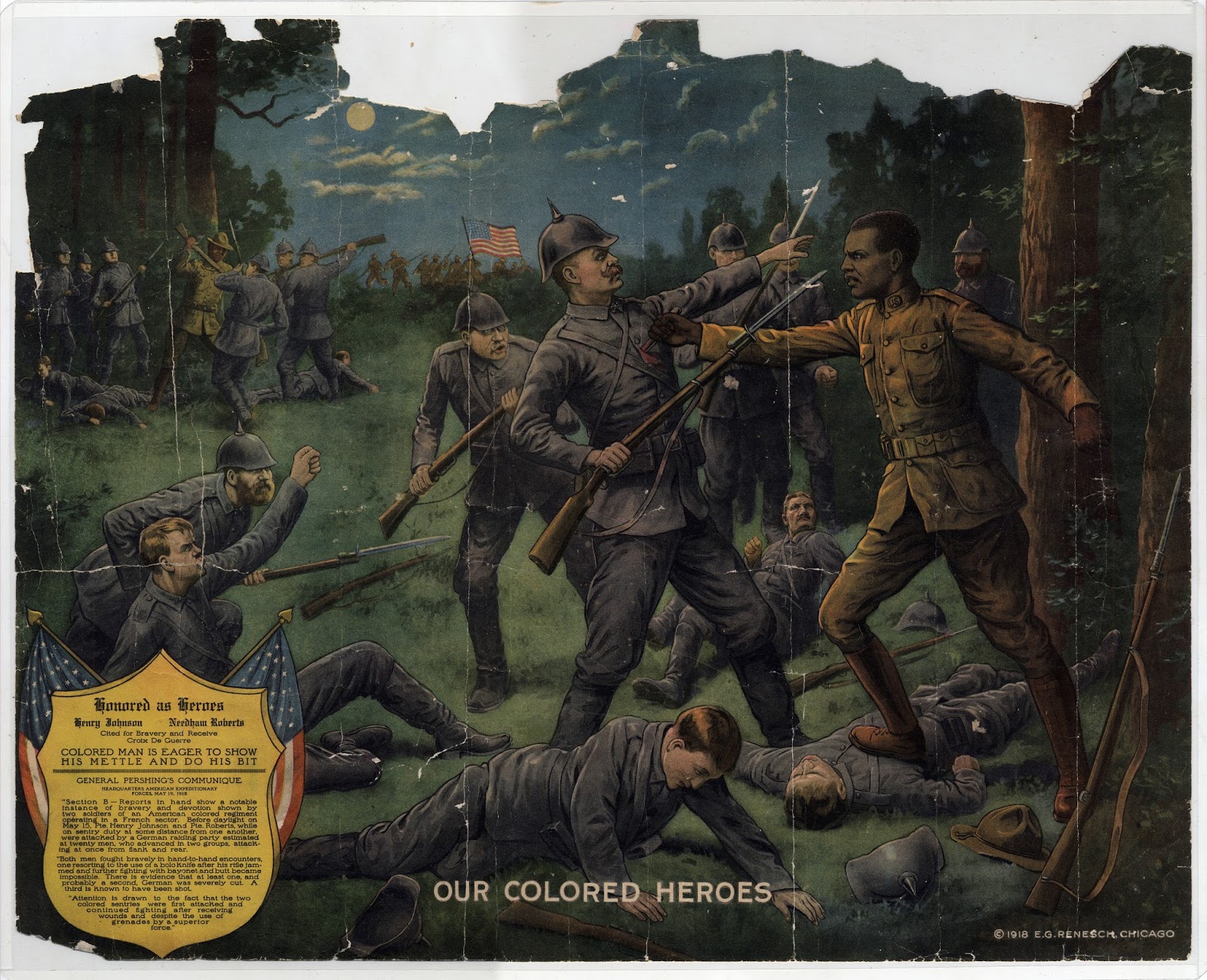
“Our Colored Heroes” was published in 1918 to celebrate the bravery of Sgt. Henry Johnson and Pvt. Needham Roberts of the 369th Infantry Regiment, 93rd Division who defended themselves against at least 12 German soldiers during a raid. Sgt. Johnson managed to defend himself and save Pvt. Roberts using hand-to-hand combat and a knife and saved both men from becoming prisoners of war. Sgt. Johnson was posthumously awarded the Medal of Honor for this courageous act in 2015.
Source: http://teva.contentdm.oclc.org/cdm/singleitem/collection/p15138coll18/id/2332/rec/1


The only combat divisions for black men at the time were the 92nd and 93rd Divisions. The 92nd Division, also known as the “Buffalo Soldiers Division,” was composed of drafted men from all over the United States. Most of the men in the 93rd Division were members of National Guard units in Connecticut, the District of Columbia, Illinois, Maryland, Massachusetts New York, Ohio and Tennessee or men drafted from South Carolina.

Service abstract of Pvt. John Tender of Union City, TN. He was a member of Co D, 369th Infantry Regiment, 93rd Division was severely wounded in action around October 20, 1918. The men of the 369th Infantry Regiment are famously known as the “Harlem Hellfighters” because the majority of the men in this regiment came from the militarized New York National Guard 15th New York Infantry Regiment.
Source: http://teva.contentdm.oclc.org/cdm/compoundobject/collection/p15138coll38/id/6026/show/5991/rec/7


Black men in these combat divisions, like Sgt. Henry Johnson and Pvt. Needham Roberts of the 93rd Division, were initially celebrated for their heroic feats, but their fame faded quickly. A century later, these men are two of the most famous servicemen to fight in World War I. At this time, only two African American men have been awarded the Medal of Honor for their World War I service: Cpl. Freddie Stowers and Sgt. Henry Johnson, both of the 93rd Division. There are doubtless many other black servicemen whose stories of bravery are waiting to be told.

Photograph from the Gold Star Record of Pvt. Jim Granberry of Mt. Pleasant, TN. He was a member of Co L, 368th Infantry Regiment, 92nd Division was killed in action on September 29, 1918, during the Meuse-Argonne Offensive. Due to strictly enforced segregation during training and military official rivalries, the 92nd Division was given little to prepare them for their role in this offensive, especially the men of the 368th Infantry Regiment.
Source: http://teva.contentdm.oclc.org/cdm/compoundobject/collection/p15138coll26/id/4860/rec/2


The Library and Archives holds gold star records for black servicemen who died during the war, as well as service abstracts for black Tennesseans who served during the war.


The Tennessee State Library and Archives is a division of the Office of Tennessee Secretary of State Tre Hargett

Friday, February 2, 2018

Tennessee State Legislative Records shed historical light on Reconstruction

By Caleb Knies

The U.S.’ Reconstruction Era following the Civil War (1860-1865) is a historical quandary; black Americans experienced freedom from enslavement, opportunities for economic and social growth, but white insecurity over this freedom saw the development of de facto and de jure Jim Crowism, creation of the KKK and start of a new chapter in the nation’s painful and complicated race relations. So many opportunities opened and explored, yet so much violence and hate; it is easy to understand why there is much debate over this important, but melancholy era in American history. The social and cultural atmosphere of the era was abuzz with excitement tinged with fears and memories of violence, and at the center of it all, at least for a while, was Tennessee’s General Assembly.

Horace H. Harrison used this ticket to vote for the abolition of slavery Feb. 22, 1865. A handwritten note on the back reads: "Copy of a ticket I voted on the 22nd of Febry 1865 to ratify the amendment to the state constitution abolishing slavery in the State of Tennessee. Horace H. Harrison."
Joseph Branch O’Bryan Papers, Tennessee State Library and Archives


After abolishing slavery, by adopting the 13th Amendment to the United States Constitution, Tennessee’s state legislature set the stage, both locally and nationally, for the Reconstruction Era following the Civil War. State Congressional sessions are quite common-place, yet few maintain the historical gravity of Tennessee’s 34th General Assembly. To begin there are two distinct 34th General Assemblies in Tennessee, the 34th Assembly under Confederate rule (1861-1862) and another one, stemming from the first postwar elections in 1865, under Union control.

J. C. Buttre engraving of Governor William G. Brownlow, Governor of Tennessee 1865-1869.
Photograph Collection, Tennessee State Library and Archives


Governor Brownlow called multiple special sessions from 1866-1867, one in July 1866 to ratify the 14th Amendment to the United States Constitution making Tennessee eligible for readmittance to the Union, well before the rest of the former Confederate states. The 14th Amendment redefined citizenship, included the Equal Protection Clause - that no state shall deny equal protection of the laws to its citizens, applied the Due Process Clause to states - granting equal legal process to all citizens, and included a now-dormant Privileges or Immunities Clause - preventing states from making and enforcing laws which abridge the privileges and/or immunities of citizens of the United States. However, issues arose when so few Representatives showed up that quorum was not reached and the Senate adjourned until attendance minimums were met. It also helped that before adjourning, the Senate gave the OK to Governor Brownlow to issue arrest warrants for absent Representatives. After reaching a quorum, the General Assembly passed the 14th Amendment to the Constitution and dismissed July 24, 1866; just in time to be recognized by the federal Congressional session which opened July 26, 1866.

Excerpt from House Bill 138, June 5, 1865: A bill to limit the elective franchise.
Record Group 60, Tennessee State Legislative Records, Tennessee State Library and Archives


 Another significant issue facing Tennessee’s 34th Union General Assembly was the matter of dismantling the Confederate political machinery, namely through the passage of franchise law amendments, attempts to “grant voting privileges to some and remove it from others.” While the wording is vague, it seems the intent of the General Assembly was to grant black male Tennesseans the right to vote, while denying the voting privileges of those who supported and fought for the Confederate States of America. There are two-years of materials in our Legislative Records Collection (known as RG60) from this state legislature concerning the right to vote - known as the elective franchise. The first, a bill from the 34th Union Assembly in 1865 which limited the vote to loyal citizens; to the last, a resolution in 1867 still tweaking the verbiage of the new voting laws. Toward the end of the third session, a four-part resolution was passed that faced little challenge in remaining weeks. House Joint Resolution 349 took a four-step approach to ensuring black males were allowed to vote and hold office in Tennessee. HJR349 eliminated the word “white” from the voting sections and changed other discriminatory sections of the state constitution, struck the state’s Franchise Law, and forced the refinement and publication of the new Constitution, this one featuring voting rights for African-American men, two years before federal Franchise Laws.

An illustration from the Nov. 16, 1867, edition of Harper’s Weekly depicting a queue of African-American men waiting to cast their vote while the first man is voting.
Manuscripts Oversize Files, Tennessee State Library and Archives


Foreshadowing some of the violence that would continue well-after Reconstruction, there was a murder during the winter break of the 34th Assembly. Hon. Dr. Almon Case, Senator from Obion Co., was shot in the road outside of his home in the middle of January 1867. Still grieving the murder of his son a few days prior, Case was shot and killed by Frank Ferris, Confederate loyalist. Newspapers of the day highlighted the growing split between Unionists and those still loyal to the Confederate cause; the Nashville Press & Times focused on Cases’ Unionist reputation as motivation for murder, while the Conservative (i.e., Confederate-loyal) Memphis Daily Avalanche cited Farris’ motivation was retaliation for the death of his brother during the war. Either way, it was clear, the emotions, pain, and violence of the war would continue. Ironically, before his death, Dr. Case pushed the state for universal amnesty and enfranchisement and had helped the Ferris family before the war.

Senate Resolution 20, Jan. 24, 1867: “we have heard with deep regret of the untimely death of the Hon. Almon Case, a Member of this Body, Therefore Be it Resolved by the Senate that a Committee of three be appointed by the Speaker of the Senate to draft Suitable Resolutions expressive of our high regard for the Deceased and Sympathy with his family.”
Record Group 60, Tennessee State Legislative Records, Tennessee State Library and Archives


Rarely does one session of a state Congress get to handle so many hot-button topics, but when the impetus is to reunite a nation and reorganize a state, there are no topics too controversial or too challenging to be faced. The whole focus of Tennessee’s 34th General Assembly was to re-establish a functional, working government that sought to create freedoms for its people. If you are interested in researching legislation from the 34th General Assembly, check out our online index here: http://tnsos.net/TSLA/rg60/


The Tennessee State Library and Archives is a division of the Office of Tennessee Secretary of State Tre Hargett

Thursday, January 25, 2018

Library and Archives Hosts Free Workshop on African-American Family Research

Connecting families with records that tie them together is often a barrier in African-American research. On Feb. 17, the Tennessee State Library and Archives will host a free workshop on African-American genealogy.

Family portrait of Henry W. Allen, Catherine B. Allen, and Minta B. Allen. Daybook entry under Mrs. H. W. Allen.
Calvert Brothers Studio Glass Plate Negatives
Tennessee State Library and Archives


Patrons will watch Discovering the Missing Threads and Patches in my Family’s History: A Pre-recorded Webinar and Discussion featuring Deborah Abbott, Ph.D. Abbott is a professional genealogist who specializes in advanced African-American research, manuscript collections and genealogy methodology. She has also been highlighted on various projects with Ancestry.com.

"Anyone interested in their family's history can find a wealth of information at the Library and Archives. I'm honored this workshop will highlight the collections and records available to the public that traces African-American history in Tennessee," said Secretary of State Tre Hargett.

Dr. Deborah Abbott, Ph.D.
Abbott will highlight how genealogists shouldn’t ignore the basics. Her webinar demonstrates how to understand all records and the history that surrounds them which can bridge the gap between slavery and freedom.

Certified genealogist and fellow of the Utah Genealogical Association, J. Mark Lowe, will moderate the discussion.

The workshop will be 9:30 a.m. until 11 a.m. CST Saturday, Feb. 17, in the Library and Archives auditorium.

The Library and Archives is located at 403 Seventh Ave. North, directly west of the Tennessee State Capitol in downtown Nashville. Free parking is available around the Library and Archives building. Although the workshop is free and open to the public, registration is required due to seating limitations in the auditorium. To reserve seats, please visit https://abbottworkshop.eventbrite.com.


The Tennessee State Library and Archives is a division of the Office of Tennessee Secretary of State Tre Hargett

Friday, November 17, 2017

Fisk University in the Great War

By Allison Griffey

Like other schools, Fisk University contributed to the war effort during World War I. University leaders promoted the war effort and inspired students to participate. Two professors, Dexter N. Lutz and Leo E. Walker, joined the service not long after war was declared. On the homefront, professor Isaac Fisher coordinated many patriotic events on campus, such as lectures and flag raising ceremonies. He inspired students by linking patriotism with increased civil rights since the war had created new opportunities for African-American at home and overseas. Fisk instituted weekly military training for its male students through the Students’ Army Training Corps and converted its facilities to host over 600 black soldiers on-site.

Odie Falls Jennings, 1918

Tennessee World War I Gold Star Records, 1918-1924

Jennings was a member of Fisk’s Students’ Army Training Corps when he died at age 20 of influenza and pneumonia during the global Influenza Epidemic of 1918. The S.A.T.C. was a popular choice for college-age men, since it allowed them to continue their studies while joining the military and training on the homefront.


Fisk was one of three black institutions, alongside Howard University and Atlanta University that collaborated to establish the first black officers' training camp at Camp Dodge, Iowa. Black college students were instrumental in the formation of this camp, at least in part because of the direct impact the draft had on their lives. The Selective Service Act of 1917 called for draft registration of American men regardless of race. While some African-American were hesitant to support the United States' involvement in the war, many hoped that participation might lead to securing equal rights for the black population. Over 370,000 African-American men were inducted into the army. The military remained segregated and most black soldiers were assigned to service units that performed manual labor, though the army did create two combat divisions for African-American troops.


Letter to Governor Tom C. Rye from F. A. McKenzie, President of Fisk University, April 7, 1917

Governor Tom C. Rye Papers, 1915-1919

These documents describe the willingness of the African-American students at Fisk University to participate in the war effort. McKenzie also suggests organizing a network of African-American schools in Tennessee to create programs for military training and volunteer service in organizations such as the Red Cross.


Women at Fisk also worked industriously to “do their bit.” Their auxiliary chapter of the Red Cross produced 450 bed shirts and 100 knitted items for servicemen. Additionally, black women joined in the war effort by leading liberty loan drives, hosting rallies, registering nurses, and supporting black servicemen through clubs such as the National Association of Colored Women (NACW), Young Women's Christian Association (YWCA), Red Cross, and women's auxiliaries for black soldier unit. Ella Brown, dean of women, advocated for food conservation and asked students to take an active role addressing food shortage issues overseas. Professor Fisher also arranged for leading black women in the community to share their views on the war with soldiers. These lectures were given in part because professor Fisher believed women’s’ voices were as necessary to hear as men’s’ and because he hoped that the women would inspire soldiers by reminding them of the women in their lives.

Charter members of Fisk University Auxiliary, Nashville Chapter, American Red Cross, circa 1918

Davidson County Women in the World War, 1914-1919

Members of the group (alphabetical): Misses Abigail Jackson, Chairman, Instructor in Mathematics, Felina G. Blaine, Velda T. Brown, Lucy Brewer, Helen M. Burrell, Grace B. Broyles, Mabel E. Campbell, Emmie F. Drake, Tommie Sue A. Fosta, Pearl C. Haynes, Flay M. Henderson, Arah L. Horton, Florence B. Jackson, Clara W. Johnson, Clara L. Langrum, Ada B. Lewis, Ferris W. Lewis, Andrades S. Lindsay, Alma A. Oakes, Manila L. Owens, Roselyn L. Purdy, Nellie A. Randolph, Altamese C. Roberts, Ruth I. Rowan, Valda E. Sanders, Margaret A. Slater, Moirselles M. Stewart, Ethelynde J. Sutton, Alice M. Thomas, Isabel B. Walden, Annie G. Quick, Mrs. Ella W. Brown, Dean of Women and Mrs. M. S. Crosthwait, Registrar.


The Tennessee State Library and Archives is a division of the Office of Tennessee Secretary of State Tre Hargett

Tuesday, June 27, 2017

Immaculate Mother Academy

By Zachary Keith

Plate 131 of 1897 Sanborn Atlas of Nashville (updated 1911) that shows Immaculate Mother Academy, including the 1907 addition.
Tennessee State Library and Archives Map Collection


Nashville’s street names reveal much about its past. Drexel Street, a seemingly insignificant side street that runs between Seventh and Eighth avenues, is a remnant of an important half-century of our city’s history. It was named for Saint Katharine Drexel, founder of the Sisters of the Blessed Sacrament, and the second American canonized by the Catholic Church. After a plea from the head of Nashville’s Roman Catholic Diocese, Bishop Thomas Byrne, Drexel agreed to establish a private Catholic school for Nashville’s African-American youth. In February 1905, she purchased the property between Stevenson (Seventh Avenue) and Ewing streets across from Central Street (Drexel Street) from Samuel J. Keith for $25,000, without disclosing her purpose.

The Nashville American, Feb. 14, 1905.

Samuel J. Keith, Colonial Dames of America Portraits in Tennessee Painted Before 1866
Tennessee State Library and Archives Photograph Collection


Keith discovered Drexel’s plan for the property from the Nashville American article. Outraged, he attempted to buy back his land and house from Drexel, even offering a $2,500 charitable donation in addition to the purchase amount. The white neighbors also reacted poorly to the idea of an African-American school nearby, ardently protesting its construction and nearly filing an injunction in the county court.[1] The residents petitioned the city council to open Central Street (present-day Drexel), effectively condemning the purchased building, stating “that they would do all in their power to prevent the establishment of the school.”[2]

Drexel stood her ground and the Academy of the Immaculate Mother opened Sept. 5, 1905, to a class of 50 female students. In 1907, the student population grew to 195 and the school needed to expand, thus a new building was constructed next to the original house. By 1908, over two hundred students packed the halls and by 1921, the then coed school boasted eight grade levels, 4 teachers and 235 students.[3]

From 1905 until 1954 the Academy of the Immaculate Mother served as an educational institution for African-American boys and girls as well as a normal school for aspiring African-American teachers.  In 1954, Nashville Catholic schools became some of the nation’s first to adhere to Brown v. Board of Education and the students of Immaculate Mother Academy transferred to Father Ryan and Cathedral School and the school closed.[4]   Immaculate Mother’s alumni included Robert E. Lillard, one of Nashville’s first African-American city councilmen, lawyer and judge.[5]

Addendum: The back of a postcard of the academy owned by the Sisters of the Blessed Sacrament contained the inscription "Our first Im. Mother's convent (the frame bldg.). It had been a slave market, as shown by sign-boards we found in the cellar." However, an exhaustive search has not been able to corroborate this fact other than uncited mentions in various publications.

Immaculate Mother Academy students sitting on the front steps of the 1907 addition
Courtesy of the Archives of the Sisters of the Blessed Sacrament


1907 addition to the Immaculate Mother Academy
Courtesy of the Archives of the Sisters of the Blessed Sacrament

Students standing in front of Immaculate Mother’s Academy, approximately 1941
Courtesy of the Archives of the Sisters of the Blessed Sacrament


For further reading on Drexel see Katharine Drexel: The Riches-to-Rags Life Story of an American Catholic Saint by Cheryl C. D. Hughes.

For further reading on Immaculate Mother Academy and development of that neighborhood see Steven Hoskins dissertation: A Restless Landscape: Building Nashville History and Seventh and Drexel


The Tennessee State Library and Archives is a division of the Office of Tennessee Secretary of State Tre Hargett


ENDNOTES

[1] “Ready for opening.” The Nashville American, Sept. 4, 1905.
[2] “Petition Council: Neighbors want Central Street opened through Keith land.” The Nashville American, May 26, 1905.
[3] Ryan, James. Directory of Catholic colleges and schools. Washington: National Catholic Welfare Conference. Bureau of Education, 1921.
[4] Hoskins, Steven (2009). A Restless Landscape: Building Nashville  History and  Seventh and  Drexel  (Doctoral dissertation) Middle Tennessee State University.
[5] Wynn, Linda T. “Robert Emmett Lillard” Tennessee Encyclopedia of History and Culture.