Showing posts with label photography. Show all posts

Friday, July 8, 2016

African-American Portraiture

"It is a peculiar sensation, this double-consciousness, this sense of always looking at one’s self through the eyes of others, of measuring one's soul by the tape of a world that looks on in amused contempt and pity."


W. E. B. Du Bois, The Souls of Black Folk


By Will Thomas

During the 19th century, systemic racism influenced the ways in which African Americans were represented in art and illustrations. They were often depicted as nameless slaves or servants and in other ways which were, as Frederick Douglass put it, "made to harmonize with the popular idea of Negro ignorance, degradation and imbecility."

However, Douglass and others realized that photography could also be a powerful tool to help change those ideas. In 1900, civil rights activist and Fisk University graduate W. E. B. Du Bois put together the “Exhibit of American Negroes” at the Exposition Universelle in Paris, France. The exhibit included hundreds of photographs of African Americans - and their homes, schools, businesses, and churches - in order to counter negative stereotypes.

Ellen Gordon and her African-American nurse, ca. 1850s. Carte de Visite Collection.


In Nashville, many of the portraits taken by Calvert Brothers Studio echo the positive portrayal of African Americans informing Du Bois' exhibit. The studio, owned by English immigrants Ebenezer and Peter Ross Calvert, did a fair amount of business with Nashville's African-American community, including many repeat customers, between 1888 and 1903.

While that does not necessarily place the Calverts at the forefront of the civil rights movement (for example, they also did portraits of minstrel show troups), it does suggest that a significant number of African Americans in Nashville felt comfortable doing business with them. The portraits of African Americans were also in no way different from or inferior to (artistically, stylistically, or technically) those produced for their European-American clientele.

By about 1910, it appears that the business the Calverts did with Nashville's African-American community had significantly dropped off. The Nashville Globe, Nashville's African-American newspaper, offers a possible explanation. The Globe heavily encouraged the patronage of African American-owned businesses, and there are several examples from 1907 of the newspaper's promoting African American-owned photography studios.


Newspaper scans, Nashville Globe. Newspaper Microfilm Collection


These are some of the African Americans photographed by the Calverts:


Buck Colbert Franklin (1879-1960)


Buck Colbert Franklin, Nashville, 1901. Calvert Brothers Studio Glass Plate Negatives.


Buck Colbert Franklin grew up in Indian Territory (now Oklahoma). He began attending Roger Williams University in Nashville and, in 1903, he transferred to Atlanta Baptist College (renamed Morehouse College in 1913). Franklin became a lawyer and opened a law office in Tulsa, Oklahoma, one month before the 1921 race riot. Although his office was destroyed in the riot, he represented African Americans in lawsuits seeking compensation for the destruction of their businesses and property. He was also the father of renowned historian John Hope Franklin.


Dr. David Wellington Byrd (1886-1945)


Dr. David Wellington Byrd, Nashville, 1899. Calvert Brothers Studio Glass Plate Negatives.


Dr. David Wellington Byrd was the chair of the literary department at Central Tennessee College (CTC), which was begun by the Freedmen's Aid Society of the Methodist Episcopal Church in 1867. He later received a medical degree from CTC's medical department (which was split off to form Meharry Medical College in 1915). He was also president of the National Medical Association (the national organization for African-American physicians) from 1916 to 1917.


Flossie B. Jackson


Flossie B. Jackson, Nashville, 1899. Calvert Brothers Studio Glass Plate Negatives.


In 1900, Flossie B. Jackson graduated from the pharmaceutical department at Central Tennessee College, passed the examinations of the State Board of Pharmacy, and became a registered pharmacist. She was a member of the Tennessee Pharmaceutical Association and worked at Jackson's Drug Store in Memphis, which was owned by her brother, Dr. George R. Jackson.


Willie Cooper


Willie Cooper, Nashville, 1901. Calvert Brothers Studio Glass Plate Negatives.


Willie Cooper was a substitute teacher at the Merry School for the 1909-1910 and 1910-1911 school years. The Merry School was an African-American elementary school located on Springhead Street (now Andrew T. Whitmore Street), southeast of Nashville City Cemetery.


Henry Allen Boyd (1876-1959)


Henry Allen Boyd (seated on the left) and family members, Nashville, 1899. Calvert Brothers Studio Glass Plate Negatives.


Henry Allen Boyd was a founder and editor of the Nashville Globe. He became the manager of the National Baptist Publishing Board upon the death of his father, Rev. Richard Henry Boyd, in 1922. He also produced the National Jubilee Melody Song Book, one of the first hymnals that set 19th century slave spirituals to musical notation. Boyd's sister, Lula, was also a classmate and close friend of B. C. Franklin at Roger Williams University.


Dr. Robert Fulton Boyd (1855-1912)


Four African-American children photographed for Dr. Robert Fulton Boyd, Nashville, 1899. Calvert Brothers Studio Glass Plate Negatives.


Dr. Robert Fulton Boyd was born in Giles County. He graduated with honors from the medical department at Central Tennessee College in 1882. He received his degree in dentistry from there in 1887 and opened his medical practice in Nashville that same year. He rose to national prominence and became the first president of the National Medical Association.


Benjamin ("Ben") J. Carr (ca. 1875-1935)


Benjamin J. Carr, Nashville, 1899. Calvert Brothers Studio Glass Plate Negatives.


Benjamin ("Ben") J. Carr was the porter for the Tennessee Senate and Supreme Court from about 1890 to 1910. He was responsible for establishing Hadley Park, involved in the founding of Tennessee Agricultural and Industrial College (now Tennessee State University), the president of the Negro Farmers Alliance in Tennessee, and, in his final years, a realtor.


A free exhibit, titled "Tennesseans Through the Lens: Portrait Photography in Tennessee," featuring these and other images, opened in May in the lobby of the Library & Archives building. Information about this exhibit can be found at: http://tslablog.blogspot.com/2016/05/free-exhibit-showcasing-historic.html.

You may also view other images from the Calvert Brothers Studio Glass Plate Negatives Collection on the Tennessee Virtual Archive (TeVA) at http://teva.contentdm.oclc.org/cdm/landingpage/collection/p15138coll24 at the Tennessee State Library and Archives.


The Tennessee State Library and Archives is a division of the Tennessee Department of State and Tre Hargett, Secretary of State

Monday, May 9, 2016

Free Exhibit Showcasing Historic Photographs Opens at Library & Archives


As the saying goes, a picture can be worth a thousand words. That's especially true in historical research, where old portrait photographs can tell us about the mannerisms, clothing, hairstyles and even cultural norms of people who lived decades ago. That's one of the reasons why the Tennessee State Library & Archives has opened a new exhibit showcasing some of the thousands of photographic portraits it has collected on behalf of the state's residents.

The free exhibit, titled "Tennesseans Through the Lens: Portrait Photography in Tennessee," opens this week in the lobby of the Library & Archives building. The exhibit will be available for viewing anytime during the Library & Archives' normal operating hours, which are from 8 a.m. until 4:30 p.m., Tuesdays through Saturdays.

The exhibit offers insights into the history of studio photography in Tennessee and how changes in that technology affected the lives of the state's residents. Some of the images date back to the 1860s, when daguerreotype was the cutting edge technology in photography. Daguerreotype captured images on silver-plated copper surfaces.

Henry Allen Boyd and family posing for a portrait at Nashville's Calvert Brothers Studio.
Image credit: Tennessee State Library & Archives


"This is an exciting new exhibit for the Library & Archives," Secretary of State Tre Hargett said. "Many people think of the Library & Archives only as a place to study documents and maps, but we also have a stunning collection of more than one million photographs, many of them portraits of famous and not-so-famous Tennesseans. I encourage people to visit the Library & Archives to see the portraits we have available."

The exhibit features photos from several of the Library & Archives' collections, including the Calvert Brothers Studio Glass Plate Negatives, the Library Photograph Collection, Looking Back at Tennessee, the Tennessee Historical Society Picture Collection, the Carte de Visite Collection and the Cabinet Card Collection.

The Library & Archives building is located at 403 Seventh Avenue North, just west of the Tennessee State Capitol in downtown Nashville. A limited amount of free parking is available around the building.

The exhibit will remain on display until August.

The Tennessee State Library and Archives is a division of the Tennessee Department of State and Tre Hargett, Secretary of State

Friday, November 20, 2015

Facial Hair and Fashion Can Help You Identify Photographs

Do you have a photograph at home but just can’t tell when it was taken? Have you looked at the clothes people in the photo were wearing and determined that they are too indistinct to nail down a specific decade? Is the only distinguishing feature on your male ancestor one glorious beard? Well, you’re in luck because you can narrow down time frame based on facial hair!

Example of a full beard and mustache. Wickliffe Weakley, c. 1890s, Cabinet Card Photograph Collection.


Facial hair, like fashion, goes in and out of style depending on social, economic, and religious trends. For instance, in the colonial period of American history through the early 1800s, men were most often clean-shaven. A clean, hairless face was associated with Puritan values, trustworthiness, and enlightenment (a beard hid the face and therefore did not promote an image of openness). However, by the mid-1800s beards were back! The Victorian era saw British military wearing mustaches, and men began to imitate the hair style for its military, masculine associations. Additionally, facial hair made a comeback among men who were exploring the wilderness and did not shave. Imitation of these frontiersmen meant linking yourself to concepts of rugged masculinity.

Perkins wears a chin curtain beard. Ray Perkins, 1899, Library Collection.


This is an example of a goatee with connecting mustache. Unidentified, c. 1870s, Carte de Visite Collection.


Several facial hair trends began during the U.S. Civil War. In the 1860s, Abraham Lincoln sported both the “chin curtain” (full beard, no mustache) and the goatee (beard only on chin, mustache optional). Many men began wearing of these beards to imitate the president. During the same time, Union Army general Ambrose Burnside popularized what became known as sideburns (hair on the sides of the face extending from the hairline to below the ears), which led to variation such as “muttonchops” (wide sideburns) and “side whiskers” (sideburns that hang below the jawline).

The officer wears “friendly muttonchops” that have extended into whiskers. “Friendly” because the muttonchops connect through a mustache. Unidentified army officer, c. 1872, Robert J. Gasper Collection.


The late 1800s and early 1900s saw the popularization of the handlebar mustache (the ends grown longer and often flared out). Beards became less desirable during the First World War, when soldiers needed to shave in order to have tight fitting gas masks. The masks, however, did not affect the wearing of mustaches. During the 1920s and 1930s, the “toothbrush” or “bottlebrush” mustache (narrow but tall, not exceeding the width of the nose) hit its peak popularity, but after World War II it fell out of style because of its association with Adolf Hitler. In the 1930s and 1940s, the “pencil” mustache (very thin, usually just above the upper lip) became popular because of its association with Clark Gable in Gone with the Wind. The goatee was re-popularized in the 1950s with the beatnik culture, and jazz and soul musicians.

This is an example of a handlebar mustache. Dr. George H. Price, 1890, Cabinet Card Photograph Collection.


Sgt. York wears a “toothbrush” or “bottlebrush” mustache. Sgt. Alvin C. York, 29 November, 1939, Dept. of Conservation Photograph Collection.


Mr. Strange wears a pencil mustache. Mr. Strange, bass singer with the concert singers of the TN Agricultural & Industrial Normal School in Nashville, 7 July 1939, Dept. of Conservation Photograph Collection.


As you date your ancestors’ photographs, keep in mind that facial hair trends were often cyclical: they were popular for a couple decades, fell out of fashion, and would often reappear at a later time. There were also individuals who kept one style most of their life, and others still who did not pay attention to trends, rather staying clean shaven or maintaining a full beard and mustache. Trends also depended on geography – a mountain man and a city slicker often favored different aspects of facial hair. Hopefully, this guide will help you figure out how your ancestor looked and when!


The State Library and Archives is a division of the Tennessee Department of State and Tre Hargett, Secretary of State

Monday, July 27, 2015

Two Lectures Highlight TSLA's August Workshop Series

During the month of August, the Tennessee State Library and Archives (TSLA) hosts two lecture events of note:


On Saturday, August 1st from 9:30 a.m. until 11 a.m., TSLA presents Victorian photography expert Lynda Massey for a lecture entitled, "Finding Your Ancestors Through 19th Century Photography." Massey's presentation will focus on Victorian era photography, and how you can identify long lost ancestors through images of period clothing, hair styles, facial hair, and even through details left behind by the photographers themselves.


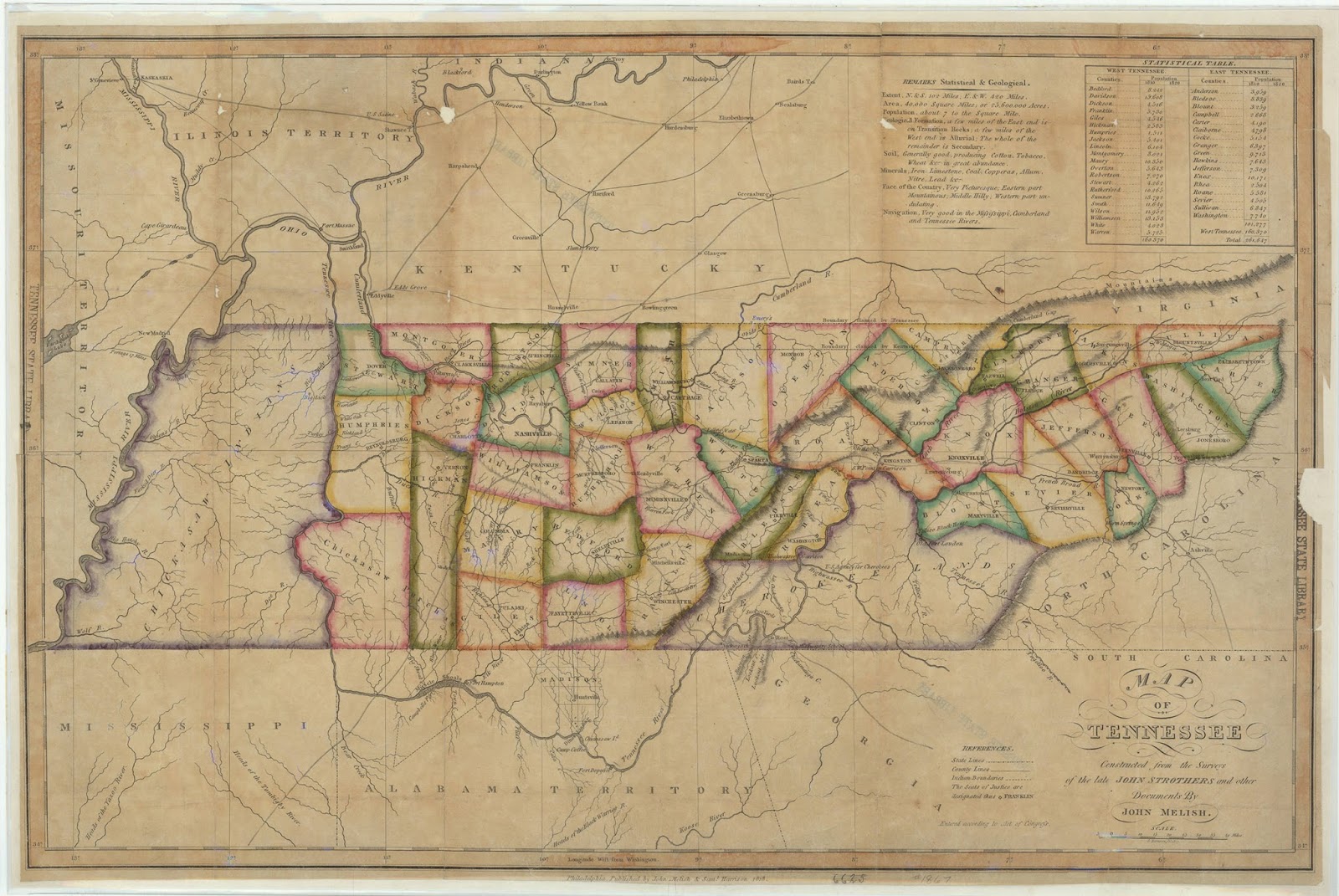
On Saturday, August 15th from 1:30 p.m. until 3 p.m., in conjunction with the opening of TSLA's historic map collection exhibit, we invite you to attend an engaging lecture by Murray Hudson, owner and proprietor of Antiquarian Books, Maps, Prints, & Globes, as he shares his knowledge about Tennessee cartography. Hudson will explore the history of map making across the entire state of Tennessee, from the early colonial borders, to the "Lost State of Franklin," to Cherokee and Chickasaw territory, and all points in between, in a lecture entitled, "The Evolution of Tennessee's Borders in Maps."

Seats are still available at both lectures. Guests interested in attending these workshop series events are encouraged to register online through Eventbrite, as the number of seats is limited. Parking is available in the front, on the side, and in back of the Library and Archives building. Patrons may register by visiting the following websites:


For more information, please contact TSLA's Public Services at (615) 741-2764 or by email at: workshop.tsla@tn.gov.

The State Library and Archives is a division of the Tennessee Department of State and Tre Hargett, Secretary of State.

Tuesday, July 14, 2015

TSLA's Next Workshop: Using Low Tech Photos for High Quality Research

Smart phones and selfie sticks were more than 100 years away from being invented, but photography was nevertheless an important part of people's lives during the 19th Century. And those ancient photos can provide important clues even today to people who are trying to learn more about their ancestors.

In the latest in the Tennessee State Library and Archives' (TSLA) free workshop series, Nashville native Lynda Massey will coach participants in how to use those photos to assist in genealogical research.

Photos from the Victorian era can help identify long-lost ancestors through images of period clothing, hair styles, facial hair, and even through details left behind by the photographers themselves. In this workshop, Massey will explain how one can identify images by their case makers, the names of photographers and photo studio addresses. Using city directories (available at TSLA and online) to establish when photographers worked at particular addresses, researchers can even pinpoint the dates when photos were made.

Massey has been interested in photography her whole life and began collecting about 20 years ago. She repairs and cleans daguerreotypes, ambrotypes and images of all types. She is also an avid collector and authority on antique jewelry.

The workshop, which is free and open to the public, will be held in TSLA's auditorium from 9:30 a.m. until 11 a.m. Aug. 1.

Those wishing to attend must register online because seating in the auditorium is limited. Parking is available in the front, on the side, and in back of TSLA's building, which is located at 403 Seventh Avenue North, directly west of the State Capitol building in downtown Nashville. To register, visit:

http://tslaphotoworkshop.eventbrite.com

For more information on the event, call: (615) 741-2764 or e-mail: workshop.tsla@tn.gov

The State Library and Archives is a division of the Tennessee Department of State and Tre Hargett, Secretary of State.

Thursday, May 28, 2015

Photos from TSLA Decorate New Bass Pro Superstore in Memphis

Since its grand opening last month, the Bass Pro Shops superstore in downtown Memphis has earned high praise from those who have toured the facility. The New York Times used the word "stunning" twice in the first six paragraphs of its article describing the 32-story-high building on the Mississippi River's shoreline.

Bass Pro Shops' new location is more than just a place where people can buy hunting and fishing gear. Located in The Pyramid, once the city's main venue for sports and entertainment events, the store is part of a complex that includes a restaurant, a bowling alley, an archery range, a man-made cypress swamp and a hunting lodge-themed hotel.

What visitors might not realize as they browse through 535,000-square-foot building is that many of the striking photographs of nature scenes that they see along the walls come from the Tennessee State Library and Archives.

A man fishing from his boat at Cove Lake State Park near Caryville (1938).
Tennessee Department of Conservation Photograph Collection.


Jeff Harper, a graphic designer for Bass Pro Shops, said details like interior decorations are so important to store development that they are discussed in a planning process that sometimes begins a year or two prior to the opening of new locations.

Harper said it's important that imagery accurately depicts the natural features and plant and animal life found in the areas where the stores are located.

"We like to regionalize our stores as much as possible," Harper said. "That way, they are uniqure and tie into their communities a little bit better."

A man fishing at Bald River Falls in the Cherokee National Forest (1947).
Tennessee Department of Conservation Photograph Collection.


Harper said Bass Pro officials looked at hundreds of images on the Tennessee State Library and Archives' website. Many of those photos were selected for the store and the hotel. They depict scenes showcasing Tennessee's natural beauty as well as people enjoying outdoor activities.

"The photos we selected and ultimately used were perfect for what we were looking for," Harper said.

Bass Pro maintains its own photo archives, which produced some of the decorative images found in the Memphis store. However, Harper said it's been a common practice to search state and local libraries to find location-specific photos for Bass Pro locations across the country.

Harper credited the Tennessee State Library and Archives for its assistance on the project, particularly in meeting some of the tight deadlines required to get the location open on schedule.

"I know they bent over backwards to help me," Harper said.

"It's great that Bass Pro Shops chooses to customize its stores with scenes that are familiar to its customers," Secretary of State Tre Hargett said. "I'm thankful that the State Library and Archives was able to make a significant contribution to a project that's going to be so important to the future of downtown Memphis."

Hikers on the trail near the top of Mt. LeConte, Great Smoky Mountains National Park (1950).
Tennessee Department of Conservation Photograph Collection.


To find photos at the State Library and Archives, search online at: http://tnsos.org/tsla/imagesearch/index.php or contact the public services division staff at (615) 741-2764.


The State Library and Archives is a division of the Tennessee Department of State and Tre Hargett, Secretary of State. 

Thursday, December 11, 2014

Tennessee's starring role in Elia Kazan's "Wild River"

In Tennessee today, it is not unusual to see film crews around the state, whether filming a TV show like ABC’s “Nashville” or making movies like “The Green Mile,” “The Firm,” or “Walk the Line.” In 1959, however, the filming of an entire major Hollywood movie in Tennessee was a momentous occasion, especially in a small town. That year, director Elia Kazan and actors Montgomery Clift and Lee Remick were among the stars that descended on Bradley County to make “Wild River.” Most of the filming took place in the Tennessee towns of Charleston and Cleveland and on Coon Denton Island in the Hiwassee River. More than 40 local residents had speaking parts, and dozens more served as extras.

In a scene from "Wild River," Miss Ella (Jo Van Fleet) attempts to illustrate her determination to keep her land by pretending to force field hand Sam Johnson (Robert Earl Jones) to sell his beloved hunting dog "Old Blue." Sam offered to give her the dog, if she was going to stay on the island.
Department of Conservation Photograph Collection
Image online: http://tnsos.org/tsla/imagesearch/citation.php?ImageID=24121


The film dramatized the plight of rural landowners who lost their homes and farms when the Tennessee Valley Authority (TVA) built dams that flooded their land. Assistant State Archivist Dr. Wayne Moore notes, "In one of the largest uses of eminent domain power in American history, tens of thousands of Southerners had their property taken from them by the Federal government in order to build these dams and create the lakes.”

The Garth Island field hands leave the farm as the lake begins to rise.
Department of Conservation Photograph Collection
Image online: http://tnsos.org/tsla/imagesearch/citation.php?ImageID=24120


If you are interested in learning more about the people who lost their lands to the lakes created by TVA dams, TSLA has many resources to explore. Borden Deal's novel Dunbar's Cove (1957) was one of two novels on which the "Wild River" screenplay was based. Two academic studies of the subject are TVA Population Removal : Attitudes and Expectations of the Dispossessed at the Norris and Cherokee Dam Sites (1995) by Michael Rogers, and TVA and the Dispossessed : the Resettlement of Population in the Norris Dam Area (1982) by Michael J. McDonald.

TVA's trouble shooter, Chuck Glover (Montgomery Clift), and eminently worth-the-trouble Carol Garth Baldwin (Lee Remick) find romance amidst the drama in "Wild River." In the end, they have to join hands with the law.
Department of Conservation Photograph Collection
Image online: http://tnsos.org/tsla/imagesearch/citation.php?ImageID=24123


To see more images from the Department of Conservation Photographs Collection related to the movie, search "Wild River" in the TSLA Photograph Database: http://tnsos.org/tsla/imagesearch/index.php.

The movie set used as the "Garth family homestead," in the motion picture "Wild River," 1959.
Department of Conservation Photograph Collection
Image online: http://tnsos.org/tsla/imagesearch/citation.php?ImageID=24134


More about “Wild River”


The Library of Congress selected "Wild River" for preservation in the U.S. National Film Registry in 2002. http://www.loc.gov/film/essays.html

Allison Inman directed a documentary, “Mud on the Stars: Stories from Elia Kazan’s Wild River“ (2011) about how the making of “Wild River” affected people in Bradley County. View a trailer for the documentary here: https://www.youtube.com/watch?v=a2LIssesvQw.

These notes from the Turner Classic Movie website are informative: http://www.tcm.com/tcmdb/title/95886/Wild-River/notes.html

At right, "Garth Island," reached by a current-pushed ferry. This location, at Coon Denton Island, a few miles up the Hiwassee River from Calhoun and Charleston, Tennessee, was chosen as typical of bottomland before the TVA dam was closed.
Department of Conservation Photograph Collection
Image online: http://tnsos.org/tsla/imagesearch/citation.php?ImageID=24117


The State Library and Archives is a division of the Tennessee Department of State and Tre Hargett, Secretary of State.

Friday, May 2, 2014

Take a step back in time through TSLA's Arts, Crafts, and Folklife Photographs

As the Tennessee Craft Festival gets underway this weekend, we are reminded of Tennessee’s fine craft tradition and our state’s handmade legacy in the local fine craft movement. The Tennessee State Library and Archives' collection, Arts, Crafts, and Folklife Photographs is a beautiful collection of images revealing this rich Appalachian tradition of arts and crafts.


Many photographs in this collection illustrate the Appalachian legacy of handicrafts, such as woodworking, broom making, chair making, weaving, sewing, whittling, and pottery.

The photographs in this collection are only a small selection from Record Group 82: the Tennessee Department of Conservation Photograph Collection, 1937-1976. The Tennessee Department of Conservation (TDOC) was established “to work toward a program of restoration, development and conservation of our renewable and non-renewable natural resources.” Encompassing various existing divisions and commissions, TDOC added several other divisions, including a “Conservation Education Section.” A new magazine, Tennessee Wildlife (today known as The Tennessee Conservationist), was created by TDOC as a forum for sportsmen’s interests and to showcase Tennessee’s natural and cultural history.

The most efficient way of highlighting this natural and cultural history was by publishing images taken across the state. TDOC hired its first photographer, Paul A. Moore, in 1937. Other photographers employed by this department over the years were James L. Bailey, Wallace Danley, Al Marsh, Dan Grice, Bill Shipley, Bob Ferguson, Dave Murrian, Bill Cox, Aubrey Watson, Charles Jackson, George Hornal, Jim Robertson, and Tim Frazier.

Two Women Making Corn Shuck Dolls and Baskets. TeVA Arts, Crafts, and Folklife Photograph Collection.


Several of the photographs in this collection portray families or other groups of people engaged in these representative crafts or other pursuits. Tasks such as basket weaving or chair making were often embraced by all members of a family. This shared experience provided income for the family unit as well as important social interaction with one another in the days before television, radio, and other diversions. This family or other group interaction can be seen in several photographs, such as the men splitting logs together or the ladies sewing baseballs with one another.

The region experienced resurgence in the craft tradition in the 1890s, as outsiders “discovered” Appalachian culture. Several folk schools were established in the early 20th century to foster the native craft tradition. As several photographs in this series illustrate, native Southern Highlanders realized the market for the products that outsiders considered intriguing forms of folk art. Several of the images in this series show individuals demonstrating their crafts to others, perhaps with intention to sell such items as baskets, pottery, etc.

The images in this digital collection, depicting individuals and cultural traditions throughout the Appalachian region of the state, are a selection of photographs taken from the Arts, Crafts, and Folklife series of Record Group 82: Tennessee Department of Conservation Photograph Collection, 1937-1976. Record Record Group 82 as a whole (grouped into 33 series) consists of over 11,000 photographic images and about 21,000 negatives. The record group was retrieved by Mr. Mack S. Pritchard, State Archaeologist, and transferred to the Tennessee State Library and Archives in the early 1970s. View some of the photographs online or stop by to see more!

The Tennessee State Library and Archives is located at 403 Seventh Avenue North, directly west of the State Capitol building in downtown Nashville. TSLA is open Tuesdays through Saturdays, from 8 a.m. until 4:30 p.m., with the exception of state holidays. Parking is available in front, behind and beside the building.


The State Library and Archives is a division of the Tennessee Department of State and Tre Hargett, Secretary of State.

Friday, February 7, 2014

Dr. Harry Mustard Photo Album

Recently re-released on TSLA’s website, the Dr. Harry S. Mustard Photograph Album is available for viewing without watermarks and with better quality images.

This album documents the Commonwealth Fund Child Health Demonstration (CHD) study of Rutherford County, Tennessee, children between 1924 and 1928. The CHD promoted the welfare of humanity by encouraging publicly funded child health education and care, hospital construction, and county-appointed health officers. Dr. Mustard was the onsite director based in Murfreesboro, the seat of government in Rutherford County.

The album that he compiled chronicles his study of child welfare and public health issues. The photographs depict dilapidated schools and homes, poorly dressed and diseased students, inoculated children, hygiene and nutrition classes, and sanitation advances. The CDH’s biggest challenges in this grassroots effort were convincing rural parents to overcome their mistrust of the outside world and making lifestyle changes (e.g., nutrition) would improve their children’s health. According to Dr. Mary S. Hoffschwelle, an historian and expert on the Rutherford County project, the mission of improving child health hid a more ambitious goal: convincing rural counties to financially support and staff their own public health facilities. Twenty-seven communities in Rutherford County -- including such places as Christiana, Smyrna, Walter Hill, Eagleville, and Lascassas -- participated in the child health demonstration.

Rural health experiments, a legacy of the Progressive Movement and its social reform-minded adherents, focused on safe, compassionate, and efficiently delivered care. Because of the movement’s vast industrial reform, many associate progressivism with urban environments. The Mustard Album reveals that a good portion of the reform efforts encompassed agrarian interests, traditionally the backbone of the American economy. Impoverished Tennessee, with its racial and geographical diversity, was the ideal place to test the progressive theories of the child health demonstration.


Health problems were common among the rural poor and included such diseases and conditions as diphtheria, intestinal parasites, typhoid, tuberculosis, rickets, scarlet fever, and poor dental care and diet. Such conditions can be partially explained because 31 percent of the population was illiterate, leaving rural people medically uneducated. The program was successful in combating illiteracy in great part because of the close organization between parents and teachers. The album shows the progression toward improved public health care among both white and African-American families. Public health care and knowledge of self-care were almost nonexistent before the fund began its study. As soon as families made the recommended applications, the health landscape began to improve. Schools competed with each other for awards recognizing their progress. By the time the study ended in 1928, the county had built the Rutherford Hospital and inspired the Division of Public Health to operate field units in other counties. Dr. Mustard became the county’s first public health officer.

Visitors to the State Library and Archives website are invited to come explore Dr. Mustard’s images. Check it out here!

The Tennessee State Library and Archives is open Tuesdays through Saturdays, from 8 a.m. until 4:30 p.m., with the exception of state holidays. Parking is available in front, behind and beside the building.

The State Library and Archives is a division of the Tennessee Department of State and Tre Hargett, Secretary of State.

Thursday, March 28, 2013

A tip of the hat to the spring season

Spring is finally upon us. It is a season that brings with it the promise of renewal. The Christian holiday of Easter is right around the corner, and with it comes the tradition of celebrating new life and rebirth with new clothing. For ladies, the Easter bonnet, often elaborate and adorned with flowers and leaves, has come to symbolize the cycle of the seasons and the coming of spring.

Although Easter bonnets are not seen as frequently as they once were, here at the Tennessee State Library and Archives there are several portraits held in our collections that bring back those fond memories. In this blog post we not only wanted to pay tribute to those spring days gone by, but also recognize the work of one of Nashville’s most well-known photography studios.

Amber Barfield Gilmer, a former conservator for the Tennessee State Library and Archives, wrote about the Calvert Brothers & Taylor photography studio in an article published in the June 2006 edition of the Nashville Historical Newsletter. In it she wrote, “During their era, the Calvert brothers helped shape the way many Nashvillians would remember their children, their weddings, their homes, and their friends. In addition, the Calverts were often commissioned to copy pre-existing photographs, and many of the resulting copy negatives are today among the most historically valuable negatives at the Tennessee State Library and Archives.”

So as our minds turn to spring and all things new, we take a fond look to the past in this photo tribute to the Easter bonnet, and the Calvert Brothers’ Photo Collection…

Miss Ruth Boice is wearing a white formal dress with a large hat, possibly bridal attire, in this 1899 photo.
Library Collection. Tennessee State Library and Archives.

In this image, dated 1900, Margaret Kercheval is wearing a hat with feathers protruding in a curious manner. A hat with feathers that resemble horns is perhaps not the best attire for an Easter Sunday.
Library Collection. Tennessee State Library and Archives.

Martha Armstrong strikes a beautiful pose wearing a large feather hat and an off-the-shoulder dress in this 1898 photo.
Library Collection. Tennessee State Library and Archives.

Mayme Conditt flashes a Mona Lisa smile while wearing this interesting hat and fur capelet in this 1899 photo.
Library Collection. Tennessee State Library and Archives.

In what may be the winner for most unique nickname in this group of photos, Miss "Toots" Fitzhugh is wearing an elaborate floral and feather hat for this 1899 photo.
Library Collection. Tennessee State Library and Archives.

Mary C. Harris poses in a white dress with an elaborate flowered hat and flower sash across one shoulder in this 1900 photo.
Library Collection. Tennessee State Library and Archives.

Ladies were not the only ones wearing hats at this time of the year. Gentlemen were also expected to dress for the occasion, as witnessed by this image of a young couple. Mr. J.G. Martin is standing holding a straw boater hat, and his wife is seated in front of him wearing a large picture hat with flowers in this 1898 photo.
Library Collection. Tennessee State Library and Archives.

In this 1899 photo, Ruth McAllister is wearing a dark dress and very large hat trimmed in ostrich feathers and a jeweled pin. Dark clothing was not typical of Easter attire, but this dress and accompanying hat still make for a striking picture.
Library Collection. Tennessee State Library and Archives.

Miss Annie O'Connor gazes into the distance wearing a light-colored dress and beautiful multi-layered hat in this 1900 photo.
Library Collection. Tennessee State Library and Archives.

Jessie Gribble is the picture of spring, wearing a white dress and lace hat in this 1900 photo.
Library Collection. Tennessee State Library and Archives.

Another lady and her gent posing for a portrait in this 1898 photo. This young man and woman are posed in formal attire, he holding his hat, she wearing an elaborate hat and holding a parasol.
Library Collection. Tennessee State Library and Archives.

Nannie Yates is wearing an ornate feathered hat and a light colored dress in this 1898 photo.
Library Collection. Tennessee State Library and Archives.

In 1898, Miss Kate Ransom wore a hat of roses for this photo.
Library Collection. Tennessee State Library and Archives.

You can view more images like these by browsing the Tennessee State Library and Archives Photo Database, located on the TSLA website.


Please note that reproduction of these images should include the credit line: "Reproduced courtesy of the Tennessee State Library and Archives."


The State Library and Archives is a division of the Tennessee Department of State and Tre Hargett, Secretary of State.

Friday, January 18, 2013

“Looking Back” is coming to TSLA!

To commemorate the 150th anniversary of the Civil War, the Tennessee State Library and Archives has spent the last two years sending teams of professional archivists and conservators to communities across Tennessee in an effort to digitally preserve Civil War era manuscripts, artifacts, and photographs held in private hands.

Our next stop on this journey is right in our own backyard.

On Saturday, January 26th, TSLA will open its own doors to area residents who would like for us to document their Civil War era photographs, documents and other artifacts. Items will be scanned or photographed and returned to the owner within an hour. Participants will receive basic conservation supplies for their items, digital copies of the images, and the opportunity to have their Civil War memorabilia preserved, digitized, and shared online for future generations. Digital copies of these items, representing the rich Civil War heritage of Tennessee families, will become part of a virtual exhibit, “Looking Back: The Civil War in Tennessee” which commemorates the 150th anniversary of the war in Tennessee.

As part of the event, TSLA is also hosting a free workshop on Civil War photography by The Vacant Chair Studio from 9:30 a.m. to 11 a.m. At this workshop, Vacant Chair will demonstrate how traveling studios used by itinerant photographers of the era looked. Vacant Chair will also discuss the history and role of photography during the Civil War time period, as well as offering a step-by-step explanation of how wet plate/collodian photographic images were produced.

Those wishing to participate in the “Looking Back” event and the workshop must contact TSLA to make reservations, as seating and parking is limited. To reserve a time for the “Looking Back” event, phone 615-253-3470 or email civilwar.tsla@tn.gov. Patrons can register for the workshop by telephone by calling 615-741-2764 or by email at workshop.tsla@tn.gov.

Among the most unique items that we encountered during our travels is the following tintype of Henry Jenks and an unidentified individual. Jenks and a friend escaped from Libby Prison in Richmond, Virginia, and made it safely back to Union territory to rejoin their regiments. Accompanying the tintype is this pass signed by President Abraham Lincoln ordering the Secretary of War to permit Henry Jenks and his friend to rejoin their regiments. It is a fascinating story told through an image and a document that would have never been told without the foresight of one person who thought it should be shared with others through TSLA’s “Looking Back” project.

Tintype of Henry Jenks and an unidentified individual.
Digital image, Tennessee State Library & Archives.

Pass signed by Abraham Lincoln.
Digital image, Tennessee State Library & Archives.


If you have an interesting Civil War item that you would like to share, please consider a visit to the Tennessee State Library and Archives on Saturday, January 26th. Who knows, maybe your family can make Civil War history once again!

The State Library and Archives is a division of the Tennessee Department of State and Tre Hargett, Secretary of State.