Showing posts with label supreme court. Show all posts

Tuesday, October 30, 2018

Library and Archives Hosts "Family History Day" and Genealogy Workshop the Saturday after Thanksgiving

Thanksgiving is a time when many of us reconnect with family members and share stories. At the Tennessee State Library and Archives, families can also explore stories of their relatives who lived generations ago. On the Saturday after Thanksgiving, the staff at the Library and Archives is encouraging Tennesseans to visit the library and celebrate “Family History Day” by learning more about genealogical research.

Manuscripts Archivist Darla Brock presents "Genealogical Gold in Tennessee Supreme Court Records" on Nov. 24th.


Beginning genealogists are often surprised at the extent to which ordinary Tennessee citizens appear within Supreme Court records. Manuscripts Archivist Darla Brock will share eye-opening examples of genealogical treasures found in case files and court exhibits and provide tips on making the most of the online Tennessee Supreme Court Cases Database. Ms. Brock will also detail the fascinating journey taken by Tennessee’s Supreme Court records to reach their current home at the State Library and Archives. After the workshop, Library and Archives staff members will be on hand to help visitors with their research.

“The Tennessee State Library and Archives is a great place for families to learn about their ancestors and to study their genealogy, especially during the holiday season when we turn our attention to time together,” Secretary of State Tre Hargett said. “I encourage families to bring generations together by exploring the vast resources found in the state archives. You never know what you might find.”

The session will be held from 9:30 a.m. until 11 a.m. Saturday, Nov. 24, at the Library and Archives auditorium, and research assistance will be available until 4:30 p.m. While the workshop is free, reservations are required due to limited seating. To make a reservation, visit https://familyhistorydayworkshop2018.eventbrite.com.

 Please note that Library and Archives will be closed Thursday, Nov. 22, and Friday, Nov. 23, for the Thanksgiving holiday, so it is important to make reservations beforehand.

The Library and Archives is located at 403 Seventh Avenue North, directly west of the State Capitol building in downtown Nashville. Parking is available around the Library and Archives building.


The Tennessee State Library and Archives is a division of the Office of Tennessee Secretary of State Tre Hargett

Monday, April 2, 2018

From the Tennessee Supreme Court Case Files... The Theory of Superposition of History

By Caleb Knies

Too often the thought is to first “make” the history without understanding or appreciating the theories that guide well-crafted, balanced and fulfilling definitions of history. Bits of historical evidence, like Supreme Court records, photographs, even things as unexpected as landscapes, soundscapes and most other quanta of historical data are used as evidence to support a particular historian and the narrative he or she is weaving; However, those same items of historical quanta can also be used to evidence new theoretical constructs. Searching for evidence to support a new historical theory can be taxing, however, on occasion, a bit of evidence fits the model so adeptly it is impossible to stifle. A letter drafted by Lytle “Boss” Bingham, connected to four Supreme Court records, is that piece of evidence.

On the dark and snowy night of Jan. 14, 1931, Lytle “Boss” Bingham, cashier at the Hardin Co. Bank, phoned his assistant and brother, James “Jiggs” Bingham, telling him to withdraw all cash-on-hand at the bank and bring it to Boss’s home. The state bank examiner was coming the 15th or 16th, and Boss needed to make sure the cash was deposited with the Federal Bank in Jackson. Boss left home in Saltillo around 9 p.m. heading toward Jackson on TN 5/US 45. In the early morning hours, a car was heard speeding down the highway. A short time later, a warm glow emanating from the horizon sparked little interest in a farmer, but soon his son would find the cause – a burning car with a body in it. The body, believed to Boss’s, initiated a chain of events that led to the discovery of the letter from Boss on the desk of the bank president and the four state Supreme Court cases for Boss’s insurance payouts.

Somewhat like Boss’s letter, these photos are re-creations of the accident scene where Boss’s burned car was found in the early morning hours of Jan. 15, 1932, with a body inside. The original accident scene “lives” in the superposition history - it both exists and does not exist. It clearly happened, but being in that moment again is impossible. Therefore, crime scene photographs and illustrations seek to re-claim any essence of originality left, but will always fall short of being able to capture the ‘reality’ of the scene. Photograph from Mary L. Bingham v. Modern Woodmen of America, Tennessee Supreme Court Records, Tennessee State Library and Archives.

Boss’s accident occurred on a dark and snowy night, these photographs show no signs of snow. The testimonies from the cases all detail the damage to the car, yet the car in this image is undamaged. A person’s sport coat replaces the lap blanket found intact over the hood of Boss’s car. But, these pictures help us (and the courts) collapse the wave function of Boss’s accident into observable bits of historical quanta/evidence/data/etc. It is the observer then, who creates the particle or wave narrative for the quanta. Photograph from Mary L. Bingham v. Modern Woodmen of America, Tennessee Supreme Court Records, Tennessee State Library and Archives.


Before going much further, it is pertinent to introduce the theory. Quantum history is the growing historical field that uses the theories and principles of quantum mechanics to guide the theories and principles of the historical method. One of the key points of quantum physics and quantum history is the appreciation for the state of superposition. For physicists, this is the state of unmeasured particles - both everywhere and nowhere at once, operating as both individual particles and particle waves (also at once). Measured particles only act as particle or wave depending on the observer, any measurement ends the superposition state which is known as “collapsing the wave function.” For quantum historians, history exists in superposition. It is both alive and dead, past and present, yours and mine, ours and theirs - all at once, all in superposition; However, measuring history, like measuring photons, collapses the wave function and bends history to the want of the observer/historian. Unless, as is thought to be the case with the letter, observation/measurement is impossible.

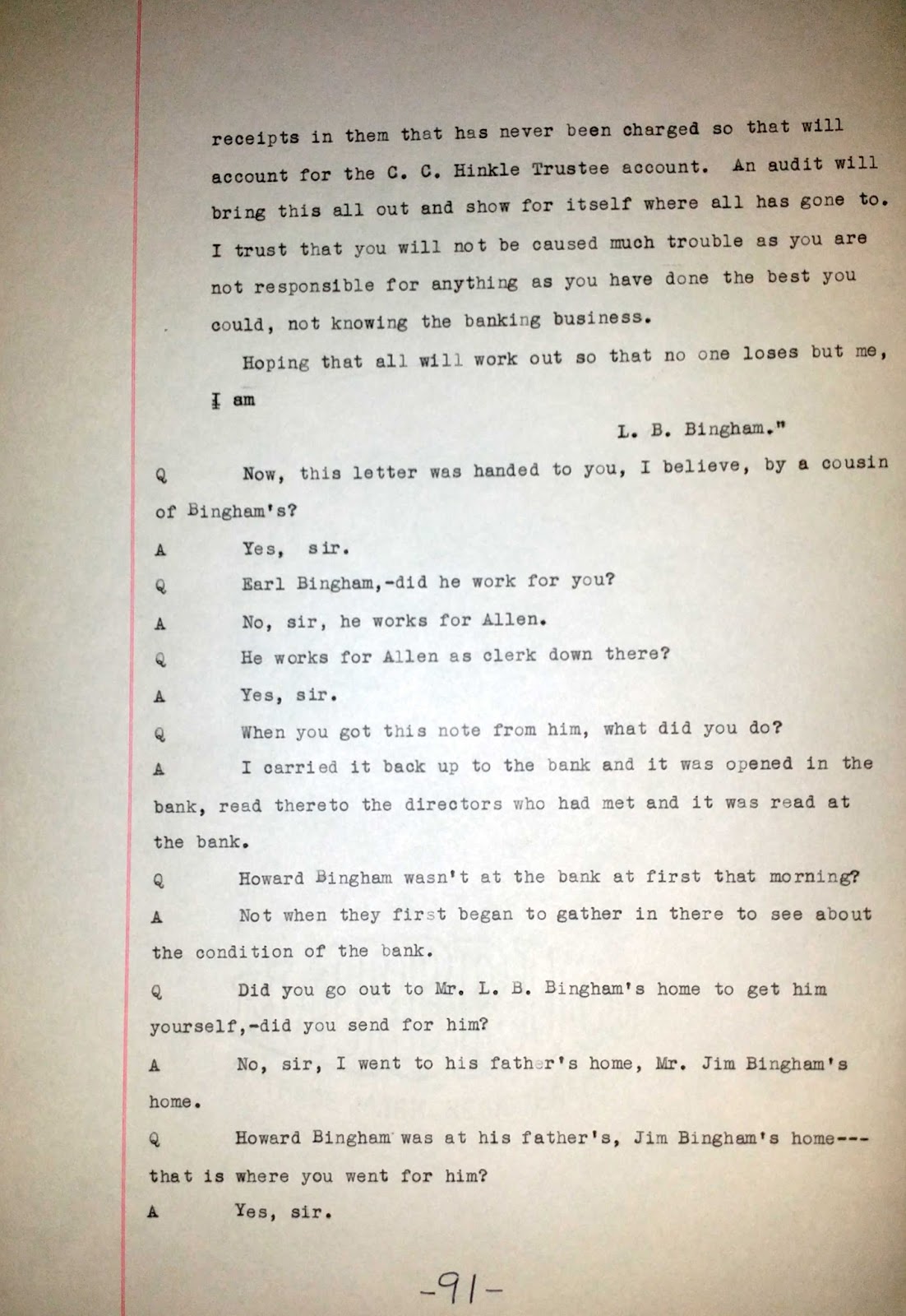
Boss’s letter lives only in historical superposition. The physical letter is missing from the historical record, but the text is held within witness testimony of three state Supreme Court cases (mentioned in the testimony of the fourth, but the actual text of the letter was not entered as evidence). The letter “exists” in the fact that it was a verified piece of evidence in a state court case, and the text of it was entered as testimony in the case; however, the letter itself as mentioned, does not exist. Boss’s letter both exists and does not exist, depending on how “existing” is appreciated and understood by the observer. Interpreting Boss’s letter as either existing or not collapses its wave-function and eliminates its state of superposition.


This is the text of the note written by Lytle “Boss” Bingham to his boss at the Hardin County Bank. The note was found the morning a body, many thought to be Boss’s, was found burning in a car outside of Saltillo. The note itself is missing, but the text was entered into Supreme Court records through the testimony of Dr. L. A. Parker, president of the Hardin County Bank, and finder of the note in question. Image from Mary L. Bingham v. Modern Woodmen of America, but the text also appears in Mary Bingham v. Business Men’s Assurance Co. of America and Verna Bingham, guard. v. Business Men’s Assurance Co, Tennessee Supreme Court Records, Tennessee State Library and Archives.


This ephemeral state of superposition adequately describes the aforementioned letter, and the whole of historical data. It shows that the observer is in control of the outcome of the evidence, to control the outcome of the historical narrative. The historical observer “measuring” historical quanta collapses his or her wave function(s) into existing as either “particle” or “wave.” Erwin Schrödinger was one of the foremost quantum physicists, actively creating, researching and developing the field long before many others even accepted its findings. Well-known, but misremembered, his cat/box paradox was a thought experiment to show the absurdity of quantum physics. Despite memetic errors, it still functions as an appropriate model for understanding how Boss’s letter, and all of history, “lives” in superposition until measured/observed by us, those seeking to interpret its information.

On one hand, the letter may be understood to not exist; the historical implications for that allow for a distinct narrative in which word-of-mouth, oral histories, and the like might fill the gap of the nonexistent letter and create a history where the meaning comes from some of the gaps in the narrative. On the other hand, the letter could be understood as existing; which creates a different narrative than a nonexistent letter, because the evidence is interpreted differently by the observer. The implications for this interpretation may be a disregard for the context surrounding the note and taking it at face value, a reliance on “factual” history and creation of historical narratives where evidence is assumed unquestionable. While interpreting the letter as either existent or not is a minor part of the larger whole of Boss’s story, the way historians interpret historical evidence deeply matters to the histories we use, create and assemble. Not unlike scientific quantum physics, Quantum History analysis can adopt and adapt the thought experiment to analyze itself and historical information.

One of the deeply intriguing collections at the Tennessee State Library and Archives is the Tennessee Supreme Court Records, home to all of the cases heard by the state Supreme Court. Scores of records (due to volume only 19th and early 20th century cases) are cleaned, folded, and ready for the public - with more added daily. The Tennessee Supreme Court Records includes cases concerning debt owed on livestock purchases, land and title debates, murders and even insurance suits. Four cases out of the many thousands held at the Library and Archives revolve around the mysterious disappearance and supposed death of Lytle “Boss” Bingham. While the full details of the Bingham cases warrant their own forthcoming blog post, a key piece of evidence in the trial is also the key piece of evidence for understanding a new historical theory.

If you are interested in researching Tennessee Supreme Court cases, check out our online index: http://sos.tn.gov/products/tsla/tennessee-supreme-court-cases.


The Tennessee State Library and Archives is a division of the Office of Tennessee Secretary of State Tre Hargett

Thursday, February 22, 2018

From the Tennessee Supreme Court Case Files: Tempe Downs v. James C. Allen et al.

By Lindsay Hager

In 1883, the Supreme Court of Tennessee ruled that Temperance “Tempe” Downs, “a free woman of color,” was entitled to a dower (one-third) of her deceased husband’s estate. Her suit, sensationalized in the Daily American (Nashville Tennessean), was considered “one of the most noted cases in the jurisprudence of Tennessee.” However, Tempe Downs’ recorded struggle to emancipate herself, remain in Tennessee and later receive her rightful inheritance as the widower of William B. Downs started over 45 years earlier when she saved the money to purchase her freedom.

Before Emancipation in Tennessee, enslaved and free black residents navigated state and local laws and customs, challenging the institution of slavery and laws that enforced white supremacy. In 1837, Temperance Crutcher (Tempe Downs) petitioned the state Legislature to allow her to remain in Tennessee upon her emancipation. Since about 1835, Thomas Crutcher, who purchased Tempe from James Barrett, had permitted her to “act as a free person” with the understanding that she “refunded” him the price of her purchase.


1837 petition to the Legislature submitted on behalf of Temperance Crutcher for permission to remain in Tennessee upon her manumission. It contains the signatures of 17 white Tennesseans who knew Tempe and the request of her enslaver, Thomas Crutcher. Part of the legislative petition collection in Record Group 60, Tennessee State Library and Archives.


Tempe paid Crutcher from money she earned working as a chambermaid at the Nashville Inn. It was there she met her husband, William “Billy” B. Downs, a free black man, who moved from Brownsville to Nashville with James B. Ferguson around 1832 to work as the steward for the Inn. Mr. William B. Downs, the son of an enslaved woman and a white enslaver, purchased his freedom in 1830 from William P. Downs, who had inherited him from his Uncle James P. Downs.

Unable to legally marry, Tempe and Mr. Downs cohabitated as man and wife and in 1837, with the consent of Thomas Crutcher, were married by Methodist minister Reuben P. Graham, “a free man of color,” who had a barber shop below the Inn. According to William P. Anderson Cheatham, employed at the Inn, “Nearly every respectable servant about town and nearly all the old settlers were there.” A reception dinner took place at the Inn following the ceremony. It was reported that from then on, despite the State’s denial of their marriage, black and white persons in the community of Nashville treated them as man and wife.


Drawing of the courthouse in Nashville as it looked in 1832, including the Nashville Inn and the City Hotel. Tempe Downs lived at the Inn and tried her cases in the neighboring courthouse. Her 1837 legislative petition would also have been heard here before the construction of the Tennessee State Capitol.

Close-up of Nashville Inn, at the corner of Public Square and Second Avenue, where Tempe and William B. Downs lived and worked. The Inn was considered the gathering place for many Jackson Democrats. The image is a lithograph by T. Sinclairs announcing the leasing and refitting of the Nashville Inn by J. Mosher, late of Mammoth Cave.


Although she paid Crutcher her purchase price, an 1831 Tennessee Law required that all enslaved people leave the state upon their emancipation and any slaveholder intending to emancipate any person was required to provide bond for their hasty removal. Despite the requests of “a number of [white] ladies and gentlemen of the city of Nashville” to grant special permission to Temperance to remain in the state, the legislature denied her request, claiming they already rejected a bill that session on the subject and another could not be passed. In order to not “be driven from the home of her nativity kindred and friends, to seek a [sic] home in the land of strangers,” Tempe had to legally remain enslaved.


1838 response of Julian Frazier, Chairman of the Legislative Committee on Propositions and Grievances, to Temperance’s Dec. 2, 1837, petition to the state Legislature. Record Group 60, Tennessee State Library and Archives.


Tempe and William P. Downs lived and worked together at the Nashville Inn until the early 1840s when she started working as a chambermaid on the Steamer Nashville that traveled the rivers to New Orleans. The same year, Thomas Crutcher conveyed Tempe to John H. Eaton and James B. Ferguson (host of the Nashville Inn) in a trust that stated they set her free as soon as possible and until then, she was “to have and enjoy her own time and be subject to her own control without the interference of anyone.”

With the money they earned, Mr. Downs purchased several lots in Nashville, including one on College Street where they planned to retire. Betsy Craighead, Tempe’s friend since childhood, testified she had planted evergreen trees on the lot “at Billy’s request.” Tragically, in 1846, shortly before the completion of their new home, he was stricken with smallpox. Downs died within a few days and was buried in the Nashville City Cemetery. The State did not legally recognize their marriage or the life they built together. Therefore, Tempe’s right to his estate and status in Tennessee were equally untenable.

Not until after the Civil War and the amendment of the state constitution in 1865 was Tempe legally emancipated and free to personally file suit against James C. Allen et al., the heirs of William P. Downs, to recover the estate of her husband. In 1866, she first filed her suit with the Freedmen’s Bureau but their court dissolved leading her to refile in the state court in 1868. Tempe testified that she was paid the $550 with the threat from William P. Downs that any further claims to her husband’s estate through her legal emancipation would be met with her expulsion to Liberia.


Newspaper excerpts about the case of Tempe Downs v. James C. Allen et al from the Daily American, July 18, 1879, and March 6, 1883, respectively. Complete article for “Tempe’s Trouble” available at the Tennessee State Library and Archives.


Though the laws at the time of the case entitled her to all the property of her husband, the law at the time of his death limited her to a claim of dower, despite her more than fifty-percent contribution to the estate. The Supreme Court of Tennessee declared that since she was functionally not “imprisoned,” though technically enslaved, before Emancipation, the statute of limitations barred her from collecting the entire estate.


Cover, cases style and parties of Tempe Downs v. James C. Allen et al. in the Tennessee Supreme Court Case files at the Tennessee State Library and Archives. Check out our growing database: http://supreme-court-cases.tennsos.org/


In 1887, the last known record of Tempe places her at 502 Melvina [Malvina] Street (now 10th Avenue) between Gleaves and Division Streets. Tempe Downs v. James C. Allen et al., detailed in the Library and Archives historic Supreme Court holdings and Tennessee Reports, spanned from 1868 to 1883 and offers valuable insight into the lives of the Downs, other local persons and places and the legal history of Tennessee. Her story illustrates the strength and persistence of enslaved and free black men and women to build their lives in Tennessee despite state-sanctioned slavery and oppression.


The Tennessee State Library and Archives is a division of the Office of Tennessee Secretary of State Tre Hargett

Thursday, October 20, 2016

Thomas Scott Marr and the Evolution of Nashville’s Urban Landscape

By Trent Hanner

If you’ve been in Nashville recently, you probably noticed the proliferation of construction cranes piercing the Music City skyline. Shiny glass towers like SkyHouse, 1212 Laurel, and The SoBro rise as evidence of a robust economy. Density has increased in residential areas as modern homes replace vintage housing stock. While many progressive projects advance, a number of structures both important and mundane have fallen to the wrecking ball. The story of Nashville’s accelerated development can be explored through the fates of several buildings designed by one noteworthy early 20th century architect.

Inspiration: The U.S. Customs House on Broadway instilled an admiration for architecture in young Thomas Scott Marr.
Library Collection


Born in Nashville 150 years ago this month, Thomas Scott Marr was reportedly inspired to become an architect as he watched the city’s Customs House being built in the 1870s. He was educated at the Tennessee School for the Deaf, Gallaudet University and, briefly, the Massachusetts Institute of Technology. The architectural firm of Marr & Holman first appears in the Nashville City Directory in 1913. Marr’s eye for design, coupled with his partner Joseph Holman’s talent for networking with the city’s elite, resulted in dozens of high profile commissions.

Demolition: Marr & Holman’s Sam Davis Hotel falls in 1985.


In 1927, The Tennessean newspaper reported that “Nashville’s skyline promises to experience an interesting addition within the year.” Marr & Holman’s 12-story Sam Davis Hotel served the city until 1985, when it fell to make way for a much larger hotel and parking garage complex at 7th Avenue North and Commerce Street. The parking garage behind the Nashville Public Library (which is itself undergoing an addition) occupies the site today.

Nearby, on 7th Avenue North between Church and Commerce Streets, a non-descript, 7-story parking garage sits. The structure was designed by Marr & Holman in 1929. In terms which sound familiar today, The Tennessean described the developer’s rationale for undertaking the project:

"The decision to build the half-million dollar parking garage was the result of a careful study of the parking situation in Nashville, the city’s staple [sic] and continuous business advance, and the demand for a downtown parking garage. The prosperity of the city and its surrounding rich area were deemed sufficient reason to make a permanent investment profitable." (Tennessean, June 21, 1929)

Indeed, the parking garage must have been a wise investment for the Pritchett-Thomas Company to have stood for nearly 90 years. But its days are numbered. The United States Congress recently approved funding for a new federal courthouse to be built on the block. Nashville will benefit from its modern new federal building, but another piece of the Marr & Holman legacy will disappear from the urban fabric.

Adaptive reuse: The Tennessean heralded the opening of Marr & Holman’s James Robertson Hotel on July 7, 1929.


Sometimes a building is fortunate enough to be reimagined so it can continue to welcome guests through its doors. This was the case of Nashville’s main U.S. Post Office (1933-34) on Broadway. In 2001, far-sighted Nashvillians reopened the Art Deco-style building as the Frist Center for the Visual Arts. The cavernous interiors of the former post office lend themselves well to traveling art exhibitions.

In other cases, buildings are renovated or repurposed in ways that increasingly lead to the use of the term “gentrification.” This may be exemplified by another of Marr & Holman’s 7th Avenue North designs, the James Robertson Apartments. For nearly 40 years, the 1929 mid-rise operated as a subsidized housing option for low-income Nashvillians. Soon, however, the building will reopen as a 191-room luxury hotel.

Endurance: The Tennessee State Supreme Court Building (1937) in Nashville.
Department of Conservation Photograph Collection


The Tennessee State Supreme Court Building on Capitol Hill is perhaps Marr & Holman’s finest structure. This 1937 Depression-era Public Works Administration project has not only survived but continues to serve its original function. The Library and Archives is proud to have it and its tenants as a next-door neighbor.

Marr and his partner left a rich architectural legacy for their hometown of Nashville. But Marr also left a monetary gift to his alma mater, Gallaudet University. That college recognizes its “deaf outstanding architect” alumnus with a page on its website and a silent film in which Marr can be seen standing before many of his Middle Tennessee designs. The video was produced in 1934 and is available at http://videocatalog.gallaudet.edu/?video=5698. The 30-minute film is a delightful opportunity to reflect on the change Nashville has seen since the firm of Marr & Holman left its impression on the city.


The Tennessee State Library and Archives holds the Marr and Holman Architectural Firm Records, 1910-1965, a Tennessee Historical Society collection. More views of Marr’s architectural work can be seen in his designs for Knoxville’s Tennessee School for the Deaf in the Tennessee Virtual Archive (TeVA).


The Tennessee State Library and Archives is a division of the Tennessee Department of State and Tre Hargett, Secretary of State

Thursday, September 8, 2016

Library and Archives Lecture Series: Unfolding Tennessee History in the Tennessee Supreme Court Case Files

Tennessee is famous for many things, but some people may not realize the state once was a hotbed for the marble industry. Tennessee marble, known for its pinkish-gray coloring and ease of polishing, has been used in many buildings across the country.

In the next installment of the Tennessee State Library and Archives lecture series, Susan Knowles, a digital humanities fellow at Middle Tennessee State University's Center for Historic Preservation, will discuss how Supreme Court case records helped her research the marble industry. Dr. Knowles' talk, which is free and open to the public, will be held from 9:30 a.m. until 11 a.m. Sept. 24 in the Library & Archives auditorium.

Dr. Knowles first explored the Supreme Court Case files, which are housed at the Library and Archives,​ while serving as museum consultant for the ​Tennessee Judiciary Museum in 2012. She will illustrate their value in a case study on the Tennessee marble industry that helped her prepare Rock of Ages: East Tennessee's Marble Legacy, an exhibit that will open Nov. 18 at the Museum of East Tennessee History. To search Supreme Court case records at the Library and Archives, please visit http://sos.tn.gov/products/tsla/tennessee-supreme-court-cases

"We are very privileged to have Dr. Knowles share some of the findings of her research with those who want to participate in our lecture series," Secretary of State Tre Hargett said. "She will demonstrate how Supreme Court records can be used to learn more about how marble had a major impact on our state's history."

Dr. Knowles' dissertation topic was Tennessee marble in civic architecture, with a focus on the individuals who built the industry as well as the political, societal and infrastructural forces that shaped it. Over a 20-year career in the museum field, she has organized numerous exhibitions and worked as a project curator for the Customs House Museum and Cultural Center, Fisk University, the Frist Center for the Visual Arts, Hofstra University, Humanities Tennessee, Nashville International Airport, Nashville Public Library, the National Museum of Women in the Arts, the Tennessee Arts Commission, the Tennessee Holocaust Commission, the Tennessee Judiciary Museum and the Tennessee State Museum.

The Library and Archives auditorium is located at 403 Seventh Avenue North, directly west of the Tennessee State Capitol in downtown Nashville. Parking is available around the library building. Although the lecture is free, reservations are encouraged due to seating limitations. To sign up for the lecture, please visit: https://courtfilesworkshop.eventbrite.com


The Tennessee State Library and Archives is a division of the Tennessee Department of State and Tre Hargett, Secretary of State

Tuesday, August 16, 2016

From the Tennessee Supreme Court Case Files: The Case of Julius J. DuBose

By Kim Wires

Here at the Tennessee State Library & Archives, we keep more than 10,000 boxes of Supreme Court cases, but not all of these cases involve laypeople who were unschooled about the law. Some of them involve judges as participants in, rather than arbiters of, legal disputes. In this case, a colorful Memphis judge was accused of helping to facilitate an illegal duel - only to be impeached by the General Assembly years later for his behavior. Here is his story:

Julius J. DuBose was born on Dec. 13, 1839 in Shelby County. He enlisted in the 9th Arkansas Regiment in 1861 and went to law school after the Civil War. He went on to become an editor, a state senator, and in 1886, a criminal court judge for Shelby County.

In 1889, state officials and several private citizens accused DuBose of violating the state’s constitution for his alleged role in a duel in Crittenden County, Arkansas 19 years before.


State, ex rel A. J. Harris et al v. J. J. DuBose
Tennessee State Supreme Court Case Files


The pistol duel was fought between two Shelby County residents, George R. Phelan and James Brizzotari. According to the case file, DuBose was accused of “not only aid[ing] and abet[ing] the same by giving encouragement there to by his presence, but in said duel appeared and acted as the second of said James Brizzotari.” Brizzotari was seriously wounded after several shots were exchanged between the two men.

On July 3, 1889, the Shelby County Chancery Court announced that it had no jurisdiction in the matter and that the authority to hear the case resided with the Tennessee General Assembly. Therefore, the case was dismissed. The state was granted an appeal to the the Supreme Court, which held a hearing in Jackson April 1,1890. The Supreme Court ultimately upheld the lower court’s decision and dismissed the case against DuBose.

At the time of the duel, DuBose had been the editor of a daily evening paper called “The Public Ledger” in Memphis. In that newspaper's June 29, 1870 issue, there was an account of the duel covering several columns.


Article from the Daily American, May 16, 1889


After more than 3,000 Shelby County residents petitioned for DuBose's removal, the Tennessee House of Representatives passed a resolution in 1893 allowing impeachment proceedings against the judge. The House issued 25 articles of impeachment.


House Resolution No. 58, from 1893.


The first article said “that, unmindful of the solemn duties of his office, and contrary to the sacred obligations by which he stands bound to discharge them, and to administer justice without respect of person, and impartially to discharge the duties incumbent upon him as a judge, he has acted in an unjudicial, tyrannical, and brutal manner toward attorneys at law practicing in said court whilst he was presiding as judge thereof.”


Articles of Impeachment for Judge Julius DuBose from the Tennessee General Assembly’s Journal, 1893


The impeachment trial lasted one month and on June 2, 1893 the legislature voted DuBose guilty of a misdemeanor while in office and forever barred him from holding any office within the state. DuBose died on March 21, 1912 in Memphis of pneumonia and is buried in Elmwood Cemetery.

You can learn more about this case and other cases in the Tennessee Supreme Court records project on our website at: http://sos.tn.gov/products/tsla/tennessee-supreme-court-cases


The Tennessee State Library and Archives is a division of the Tennessee Department of State and Tre Hargett, Secretary of State

Thursday, August 11, 2016

Students Invited to Participate in Tennessee's First Ever Student Mock Election

Governor Frank Clement giving a speech,
possibly at a re-election rally in Lebanon.
This fall students across Tennessee will be able to do something most kids can't: vote for president of the United States.

The Secretary of State's office is pleased to announce Tennessee's first ever Student Mock Election. Students in preschool through high school from all public and private schools as well as home school associations in Tennessee can participate.

Paper ballots letting students choose between Democratic and Republican presidential nominees will be provided, but schools may elect to include additional candidates or conduct elections locally in different ways.

Early voting for the mock election opens October 17 and results must be submitted by Mock Election Day, November 1. Mock presidential election results will be revealed on November 2, less than a week before the real general election.

The program also offers lesson plans created by Tennessee teachers. The goal is offer an easy way for teachers to incorporate civic engagement and citizenship into their curriculum leading up to the Student Mock Election.

The Library and Archives also offers several resources for students and teachers interested in learning more about civic education and our government at the state level, including...


For more information go visit: sos.tn.gov/civics. Read more from our press release at: http://sos.tn.gov/news/students-invited-participate-tennessees-first-ever-student-mock-election.

The Tennessee State Library and Archives is a division of the Tennessee Department of State and Tre Hargett, Secretary of State

Friday, July 15, 2016

Honoring Ida B. Wells

Tomorrow (July 16th) is Ida B. Wells’ 154th birthday. In her honor, we here at the Library & Archives want to celebrate her courage by recalling the notable Supreme Court case Ida Wells v. Chesapeake, Ohio & South Western Railway Company. This case is particularly significant because it was one of the earliest challenges of legal segregation in the United States.

Born into slavery on July 16, 1862 in Holly Springs, Mississippi, Wells was an activist, journalist, newspaper editor, and suffragist during her lifetime. In the early 1880s, she moved to Memphis and became a school teacher in Shelby County. During her summer vacations, she also attended Fisk University in Nashville.


Portrait of Ida B. Wells Barnett from Sparking Gems of Race Knowledge Worth Reading.


Congress approved the Civil Rights Act of 1875 during Reconstruction, banning racial discrimination in public accommodations. However, in 1883, the Supreme Court ruled against the act, allowing businesses like railroad companies to racially separate passengers.


Cover page from Ida Wells v. Chesapeake, Ohio & South Western Railway Company.


On September 15, 1883, Wells bought a first class ticket aboard the Chesapeake, Ohio & South Western Railway Company from Memphis to Woodstock, Tennessee. After she took her seat in first class, “the defendants by its agents forcibly and with personal violence eject[ed] her from said seat.” Wells sued the railroad company for $1,000 in damages for “unlawfully and forcibly lay[ing] violent hands on her and beat[ing] and mistreat[ing] and misus[ing] her.” She hired T. F. Cassels, a notable attorney from Memphis who had been one of the first African Americans to be elected to the Tennessee General Assembly to represent her.


Thomas F. Cassels, from 42nd Tennessee General Assembly Composite.


The Circuit Court of Shelby County awarded in favor of Wells, but the railroad appealed the case and it went to the Tennessee Supreme Court in April 1885. The Supreme Court reversed the lower court’s decision and sided with the railroad.

Despite losing the court case, Wells went on to become one of the leading African-American civil rights leaders of her time. She founded several organizations and travelled the world speaking about human rights until her death in Chicago of kidney failure on May 28, 1931.

You can learn more about this case and other cases in the Tennessee Supreme Courts Records Project on our website at http://sos.tn.gov/products/tsla/tennessee-supreme-court-cases.


The Tennessee State Library and Archives is a division of the Tennessee Department of State and Tre Hargett, Secretary of State

Friday, June 17, 2016

From the Tennessee Supreme Court Case Files: Pathkiller and Blair’s Ferry

Among the thousands of debt disputes, railroad damages, and estate settlement cases that we house in the Library & Archives Tennessee Supreme Court Records Collection, one particular case stands out. It involves a man known as Pathkiller, the last heredity chief of the Cherokee Nation.

Hereditary chiefs were those who inherited their titles and responsibilities according to the history and cultural values of their communities. A full-blooded native American, Pathkiller served as the Cherokees' leader from 1811 until his death in January of 1827. Pathkiller was among the Cherokee warriors who played a pivotal role at the Battle of Horseshoe Bend, bringing an end to the Creek War in 1814.

This Supreme Court case centered around a land dispute between Pathkiller and James Blair of Loudon County. In 1819, Pathkiller took advantage of a provision in the Calhoun Treaty and claimed a reservation of 640 acres that included the area known as Blair’s Ferry. Blair’s Ferry was on the Tennessee River in Loudon County. James Blair had already occupied and developed the land and operated the ferry when Pathkiller staked his claim. Blair countersued against Pathkiller's claim in order to regain title to the land. Thus began a lengthy court battle that continued even after both of the principal parties died.

A drawing in the case file of the disputed 640 acres of land in Loudon County, Tennessee.


The original case began in 1821 in Roane County when Pathkiller took action against James Blair, ordering him off the land. Following that trial, the court awarded judgement in favor of Pathkiller, giving him full possesion of the disputed land. The Tennessee Supreme Court granted an appeal filed by Blair, however the higher court upheld the lower court’s decision.


Tennessee Supreme Court case file: Pathkiller’s lessee v. John Blair & James Johnston, 1835.


James Blair died in 1826 and Pathkiller died the following year. Upon their deaths, Blair’s sons John and Wily continued battling for the property rights against Pathkiller’s daughter, Sarah, and her husband, James T. Gardenhire. After years of litigation, the Tennessee Supreme Court ultimately decided in favor of the Blairs, claiming that Pathkiller’s sale of the land to the Gardenhires had made his reservation claim null and void. The parties ultimately reached a compromise, and the Gardenhires agreed that they would “remove and give up all of said 640 acres with the ferry, and to remove any tenants that may be in possession of any part of the said tract…”


A report by Hugh Lawson White on the case requested by the Tennessee General Assembly, 1829.


Blair’s Ferry Storehouse was erected shortly after the legal battle and still stands today in Loudon County.


A photograph of Blair’s Ferry Storehouse from The Loudon County Herald, March 1974.


The Tennessee Supreme Court Records Project holds many more fascinating cases just like this one. These records can be a valuable tool for understanding our state’s rich history.


The Tennessee State Library and Archives is a division of the Tennessee Department of State and Tre Hargett, Secretary of State

Wednesday, April 13, 2016

Search and order Tennessee Supreme Court Cases now online

The Tennessee State Library & Archives recently launched a new online ordering system for Supreme Court cases. The new system will allow researchers to request case files in hard copy or digital scans. It will also give such information as individual case details, page counts, and copy fees. It is our hope that the online system will create an easier and more direct way for researchers to order Supreme Court records, as well as lessen the amount of wait time in processing research requests.

Once stored in the attic of the the Tennessee State Capitol building, the Supreme Court records came to the Library & Archives in dire need of restoration. Curled and brittle, covered in coal dust from the furnace pipes that fed into the Capitol’s storage space, the records were all but unusable. Our archival technical staff has worked tirelessly toward the preservation of these records for more than a decade. Staff members have meticulously cleaned off the dust and grime, carefully flattened and recorded the contents for more than 50,000 cases.

The archivists will continue this project indefinitely, as there are well over 10,000 boxes of material in storage. However, what has already been done constitutes an extraordinary achievement. The result of the archivists' work is an impressive, usable state record collection and a searchable online database for researchers.

This is an example of a case before cleaning and processing.


Library & Archives staff members have worked on the Tennessee Supreme Court project for well over a decade.


Supreme Court records provide a wealth of information of benefit to professional and amateur historians. The stories that unfold in the pages of each case are windows to personal and community life and family relationships from the past.

One can find cases concerning land issues, debt, slavery, estate disputes, criminal cases, and much more. Cases currently housed at the Library & Archives range from the beginning of the 19th Century to around 1950. They vary in size, from brief records to complete transcripts of all proceedings - sometimes involving hundreds of pages.

Some of these cases include exhibits, such as textiles, photographs, and maps. While textiles cannot be copied, photographs and maps can and often represent valuable pieces of information for researchers and genealogists.


From the East Tennessee Division Supreme Court Case Files--Fords v. Fords (1846). In his will, Lloyd Ford freed his slaves and left them his property, and his children contested the will. The Tennessee Supreme court ruled in favor of the slaves. This was a landmark case describing slaves’ basic civil rights.


From the Middle Tennessee Division Supreme Court Case Files--Mrs. Sue M. Jarnigan v. Nashville, Chattanooga & St. Louis Railroad Company (1919). Jarnigan sued the railroad company for damages. The case includes exhibit items: photographs of the wrecked train, damage and inspection reports, blue prints, and books on rules and regulation of train inspection.


From the West Tennessee Division Supreme Court Case Files--State v. Edward H. Crump et al (1916). This case involved charges of neglect of duty and corruption regarding illegal sale and distribution of liquor, gambling, and prostitution against Crump, Mayor of Memphis; R.A. Utley, Vice-Mayour and Commissioner of Dept. of Fire and Police; and W.M. Stanton, City Court Judge. Exhibits include account statements, receipts, political cartoon, correspondence of Attorney General A.Z. Estes, and lists liquor law violators.


If you are interested in researching Supreme Court cases, check out our online index: http://sos.tn.gov/products/tsla/tennessee-supreme-court-cases.


The State Library and Archives is a division of the Tennessee Department of State and Tre Hargett, Secretary of State

Monday, February 29, 2016

From the Tennessee Supreme Court Case Files: Mary A. Bower v. Ellen Lunney et al

By Kim Wires

In our ongoing work to process the Tennessee Supreme Court case files, our staff, volunteers, and interns encounter many intriguing cases. One East Tennessee case was of particular interest - the case of Mary A. Bower v. Ellen Lunney et al.


A birth certificate for Mary (Donohue) Bower (b. 1879) that was used as an exhibit during the case.


In this court case, the plaintiff, Mary Bower, sought to prove to the court that she was the legitimate daughter of Thomas J. Donohue in order to claim inheritance rights to his estate. While the case itself did not offer much intrigue, the files included an impressive collection of family history records admitted as evidence.

In June 1940, Bower sued in an attempt to prove that she was indeed the legitimate daughter and sole heir of Thomas J. Donohue and therefore was the rightful heir to his estate. In the lawsuit, Bower stated: “I just want to say that my father’s name has to be vindicated and my mother’s – that is all.”

Ellen Lunney, the estate's executor, denied her claim of kinship and alleged that Donohue was a bachelor, having never married in his lifetime, and that upon his death left everything to his sole heir and next of kin, Daniel J. Donohue, his nephew. In an effort to prove the legitimacy of Bower’s claim, the court filed numerous exhibits from both sides and considered testimony from witnesses detailing the family’s history.

Some of the exhibits included were certificates of baptism, a will, a marriage certificate, a death certificate, an inventory of the estate, Thomas J. Donohue’s obituary, 28 letters from Donohue to Bower, six deeds, a copy of a business charter, a photocopy of a Bible record, and two unidentified photographs that most likely depict Thomas J. Donohue and Anna Kirk, who was Bower's mother. The transcript also provided additional genealogy information such as the names of family members and how they were related, when and where they were married, how many children they had, their religious backgrounds, residences, and birth and death dates.


An unidentified photograph used as an exhibit during the case. This photograph could possibly be Thomas J. Donohue.
An unidentified photograph used as an exhibit during the case. This photograph could possibly be Mary A. Bower.


A correspondence from Thomas J. Donohue to Mary A. Bower, 1907.


In the end, the court ruled that Donohue was considered a bachelor because there were no marriage or divorce records linking him to Anna Kirk. The court determined that Bower was the illegitimate daughter of Thomas Donohue. The court also noted that Anna Kirk was married and living with another man at the time of her death and had children by him. Bower was awarded $1,275.54 and Lunney was awarded compensation as executor of the estate.


Obituary for T. J. Donohue used as an exhibit in the case.
When doing genealogy research, it's easy to forget that court cases can hold valuable information, especially if a case pits family members against one another. Testimony, depositions, and exhibits could be the missing puzzle pieces of your family history. This case is a wonderful example of how the Tennessee Supreme Court Records Project can be another useful tool in your genealogy research.


The State Library and Archives is a division of the Tennessee Department of State and Tre Hargett, Secretary of State