Showing posts with label Preservation Week. Show all posts

Friday, April 28, 2017

Preservation Week Tip: Sticky Tape is Evil


By Carol Roberts

April 23-29, 2017 marks "Preservation Week" highlighting the importance of preservation awareness. What do you think is one of the most damaging “fixes” for a historic item? It is sticky tape of any kind. Its official name is pressure-sensitive tape, which can be any type of Scotch tape, duct tape, masking tape or even clear contact sheets or shelf liner. The adhesive damages items in several ways.


First, adhesive completely discolors items, leaving dark stains that can completely hide any text underneath.

Second, the tape or plastic part of tape can be stronger than delicate paper and continue to break the paper at the folds or edges of the tape.

Third, tape brings up any surface item if you try to remove it. A photo emulsion is especially damaged by tape and usually the tape cannot be removed.

Finally, the damaging effects of tape usually are not reversible. A conservator will spend many hours and use several chemical solvents when removing pressure-sensitive tape and its sticky residue. Do not try this at home.


Well-intended mends are a bad idea for long term storage or preservation. So what are some of the alternatives?

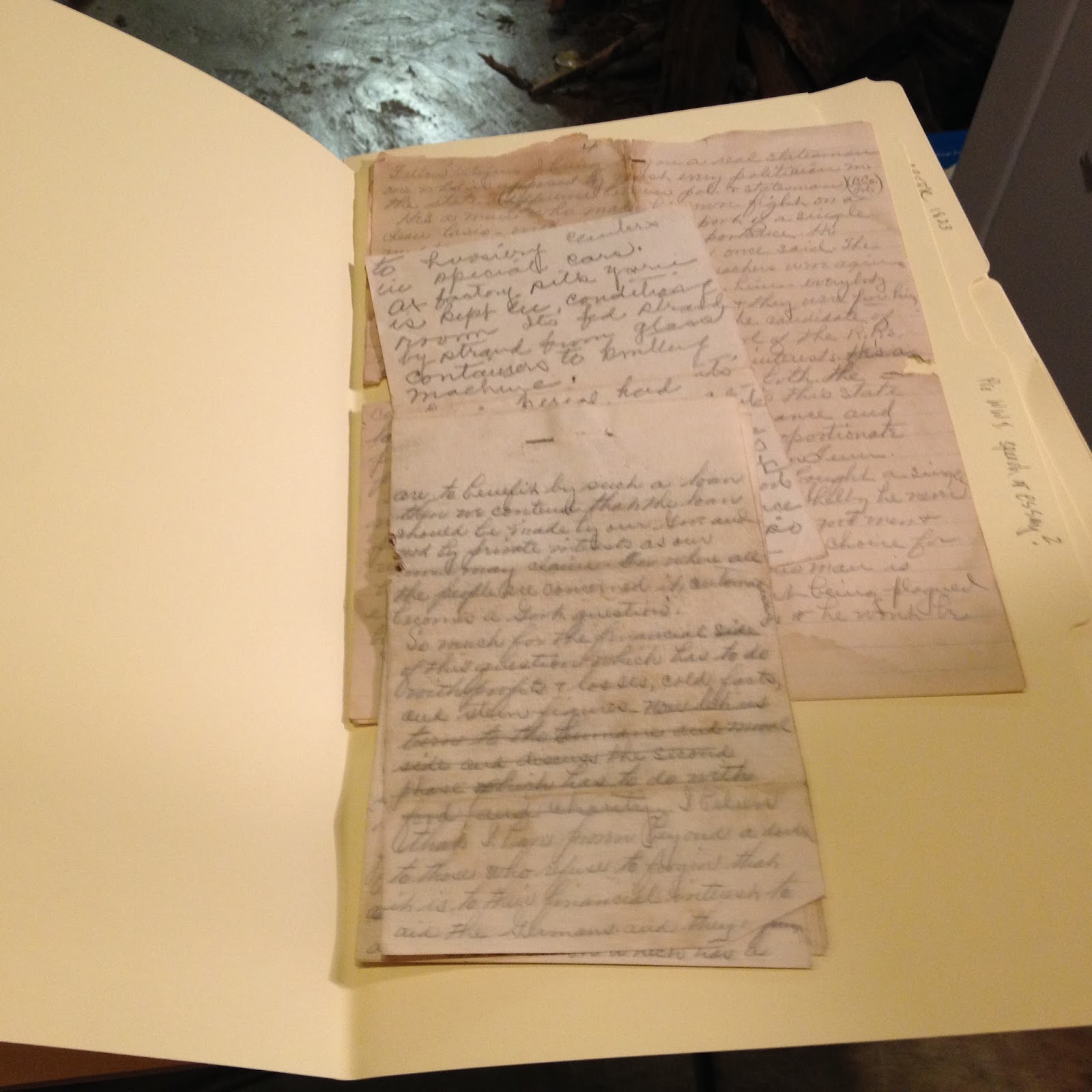
A simple acid-free folder of any kind will hold the pieces of a torn item together and support them.

A polyester (Mylar or Melinex) sleeve can also hold a delicate item in place. Polyester sleeves have a slight static charge to them and hold torn items in place within them. Also, sleeves are sealed only around the edges and do not stick to anything with adhesives.

Wrap a broken book, Bible or set of records in good acid-free paper.


A torn page in a book can be helped or supported by acid-free tissue paper. However, watch out for too many extra pieces of tissue in a book because that extra tissue will stress the spine and binding.

The best conservation techniques for a family collection - or any historic collection - are to use good storage techniques, create a good environment and avoid anything that cannot be reversed or might be difficult to remove. It is always the basic archival rule that you want to be able to return an original item to the condition in which it was found.

If you do have a valuable historic item with tape on it, store it carefully and consult a conservator.

Remember, anything with the words "pressure-sensitive," "adhesive" or “duct” should never be used in the same sentence with anything related to "conservation," "archival," "historic" or "preservation."

As a good conservator says, “tape is only good with Christmas wrapping paper.”

To read more about archival care for family collections, see these websites:


The Tennessee State Library and Archives is a division of the Tennessee Department of State and Tre Hargett, Secretary of State

Wednesday, April 26, 2017

Preservation Week Tip: Caring for Old Photographs


By Carol Roberts

April 23-29, 2017 marks "Preservation Week" highlighting the importance of preservation awareness. Here's another reminder to take care of your valuable historic items. What about all those family photographs that tell the family story? How many shoeboxes full of interesting treasures do you have? Here are a few tips for keeping them safe and well organized.


Don't touch or write on the emulsion side of any print or negative. Touch only the edges. Human oils and perspiration cause damage that cannot be reversed.

Don't write on the back with ink or use rubber stamps. Inks are acidic and may contain sulfur.

Don't use scotch tape or any type of pressure-sensitive tape on or near your photographs or negatives.

Don't use paper clips or rubber bands around prints, negatives or slides. They can rust or imprint emulsion.

Work on photographs in a clean work space without food, liquids or anything that could spill and stain a photo or cause photos to stick to one another.

Keep photographs and negatives in a dry, cool storage place. Keep conditions as constant as possible. Heat and humidity will cause crackling and peeling of emulsion. Daylight and fluorescent light will fade photographs.

Do carefully identify your photographs. Write on the margins on the back of prints with a soft lead pencil or with an acid-free pen that meets ASTM standard D-4236. Be careful not to press hard enough to leave an impression on the emulsion side of the print.

Use archival storage supplies that meet the Photo Activity Test (PAT). The PAT is a new standard that evaluates all storage supplies and makes sure the photographic emulsion does not react in any adverse way with items such as folders, photo albums or framing materials.

Do separate prints and negatives in acid-free paper envelopes with the emulsion sides away from the seams. Remember that the emulsion side of a print or negative can be easily damaged.

Make all your notes and information on the archival storage sleeve or folder rather than putting damaging marks on the backs of the original photos.


There are so many clues to history in photographs. Here are some you can use to learn more about the photos you have:

  • Identify the type of photographic process used to create the photos.
  • Look for the name of the photography studios that took the photos and where in the community they were located, if possible.
  • Study the clothing and styles of people in the photos.
  • All of these steps provide clues about the dates photos were taken.

To learn more about caring for historic photographs, see the following websites:


The Tennessee State Library and Archives is a division of the Tennessee Department of State and Tre Hargett, Secretary of State

Monday, April 24, 2017

Preservation Week Tip: Caring for Old Books


By Carol Roberts

April 23-29, 2017 marks "Preservation Week" highlighting the importance of preservation awareness. For Preservation Week, here's a reminder to take care of your valuable historic items. What should you do with those favorite rare books?

Keep them on book shelves, straight as little soldiers, just like at the library. That keeps the spines and book covers intact and carefully stored. Never pull a book off the shelf by the top edge. The upper edge of the spine breaks when pulling the top down and can break the spine cover off completely. Instead, push in on both sides to remove or replace a book.


Keep books in the best environment possible in the home. Keep them at a constant temperature and humidity because dramatic fluctuations in either of these conditions are stressful on the paper, bindings and covers - especially leather. Cool, dry and stable environments are best.

Avoid direct sunlight and fluorescent light because the ultraviolet radiation causes fading of the paper, ink and book covers.

When handling an old book, be gentle. Hold the book carefully, as if in a cradle. Do not stretch the spine when reading it. Keep the spine and text from stretching and hold it open at a 90-degree angle or less. Do not flatten or force a book down on a copier. There are new overhead copiers around these days that can provide copies without flattening them. Carefully turn the pages when paper is brittle or torn. This is a time when white cotton gloves - and the loss of dexterity you get when wearing them - can harm more than help.


Book collections need dusting like Grandma’s favorite china cabinet. Books can be dusted and gently cleaned by using a basic clean soft cloth. It is not necessary to use any chemicals because cleaning fluids often contain harmful substances. Handle books with washed and clean hands. Cotton gloves can be used when the pages aren't brittle or torn. Always handle a valuable book in a clean area to avoid getting more dirt and stains on the text.

If a book is already broken or damaged, a good acid-free box and acid-free tissue paper will do a great job of protecting it until it can be properly conserved by consulting a qualified conservator.


To learn more about archival preservation and care of books, see these technical leaflets and websites:


The Tennessee State Library and Archives is a division of the Tennessee Department of State and Tre Hargett, Secretary of State

Thursday, April 28, 2016

Tips for Preservation Week: Discovering 'Gold' Behind the Frames

Conservation and care of historical documents often reveal surprises. Recently our conservation lab staff members were working with photographs from the J. Percy Priest Collection when they made an interesting discovery. When they opened the frame on an image of Percy Priest, Harry Truman and others in a group setting, they were surprised to see that underneath was a signed portrait of President Harry S. Truman with kind remarks to Mr. Priest.

In conservation work, it is a standard practice to remove photographs from frames and store them in proper archival containers. This helps reduce fading from light sources. It also helps protect the images from dust and other harmful materials. Quality archival storage should include acid-free photo sleeves, archival boxes and the best constant environment possible. This works to keep historic photos, documents, and other items lasting well into the future. To read more about caring for historic photos see: http://www.tennessee.gov/tsla/preservation/conservationlinks.htm

Finding Harry S. Truman in the back of a picture frame was a pleasant surprise. Finding a locket of hair behind a Civil War soldier’s tintype photograph was another pleasant surprirse. Not-so-pleasant surprises have included bugs and dead mice that have become squashed behind framed items. So far, we've found no money or undiscovered copies of the Declaration of Independence.


Framed items of places and events usually are faded after many years of display. Archivists make every effort to stop the deterioration by providing proper storage. That requires the items to be removed from their frames.


Acidic cardboard backing like this example from the late 1940s needs to be removed to stop harmful chemical migration to the photographs.


Then pleasant surprises sometimes turn up hidden behind picture frames. In this case, the signed portrait of President Harry Truman.


Proper archival storage for photos includes acid-free, lignin free, and sulfite free paper envelopes. If the items will be heavily used, then proper mylar clear sleeves can be used. Digital images or copies can also be used for display and to reduce the handling of the original items.

This year, librarians, archivists, and conservators throughout the nation will observe Preservation Week on April 24 - April 30. For more information, visit: http://www.ala.org/alcts/preservationweek


The Tennessee State Library and Archives is a division of the Tennessee Department of State and Tre Hargett, Secretary of State

Thursday, May 1, 2014

Preservation Week reminds us of the importance of microfilm...

April 27 through May 3 marks this year's annual observance of Preservation Week, a week long opportunity to give libraries, archives and other institutions the chance to connect our communities through events, activities, and resources that highlight what we can do, individually and together, to preserve our personal and shared collections.

One important preservation activity of the Tennessee State Library and Archives (TSLA) is our microfilm processing program. TSLA has been producing and duplicating microfilm for over 60 years. Although much of what we film is from our own collections, we also often film county records as a part of a mutually beneficial special project to ensure preservation standards. In return, local public libraries receive copies of the microfilm, and we store copies for use by TSLA patrons, as well as maintaining the negatives in our climate-controlled vault.

Preserving Microfilm


Microfilm processing is a highly detailed, technical process. While there are workshops and seminars for microfilm training, microfilm technicians primarily learn their trade through an apprenticeship.

Keeping a set of duplicates at an off-site storage facility is one of the safest ways to ensure the survival of your records, especially in the case of theft, flood or fire. The six primary groups of records we film are:

  • Local County Permanent Records
  • County Loose Records Special Projects
  • TSLA Manuscript Collections
  • State Agency Record Groups
  • Collections on loan for microfilming
  • Newspapers


After each document organized, targeted and photographed, our microfilm technician preps the film and runs it through our microfilm processor. This process is tedious and delicate- the smallest mistake could ruin the exposure of a roll of film. TSLA is fortunate to have such highly skilled microfilm technicians.


Digital versus Film


Though there are a vast number of digital preservation mediums, microfilm is still considered the best long-term form of preservation for historic records. While digital files are useful and often more accessible to patrons, the files are subject to “bit rot” and eventual obsolescence. If kept in a proper environment, microfilm will last approximately 300 to 500 years, and even if all microfilm readers were destroyed, the information on the rolls could be accessed by simply holding the film up to a light with a magnifier. TSLA proudly maintains the stewardship of Tennessee’s treasures, and, through microfilming our collections, ensures the records will be available to our patrons for hundreds of years. TSLA has produced nearly 200,000 reels of microfilm negatives since its inception, and produces more each year.

After a roll of microfilm is processed, a quality control inspection is given, which includes a visual inspection that consists of a density and resolution check, as well as determining if there was a camera problem or operator error. In addition to methylene blue tests, this inspection ensures the film meets ANSI/AIIM standards.

Public Availability


Microfilming also allows us to sell (at cost) copies of our rolls to our patrons, which in turn allows patrons to study the film at their local archives or libraries. While not everything is available for sale due to various restrictions, many different types of records are available for purchase such as county records, newspapers, and manuscript collections. 35mm rolls are currently $25 a piece, while 16mm rolls are $20 a piece. You can browse our collections at http://www.tn.gov/tsla/Collections.htm and if you have any questions about purchasing microfilm please call 615-741-2997.

The negatives we produce are stored in our secure vault, which is kept at 55 degrees Fahrenheit and below 45 percent humidity to ensure the long-term survival of the film.


The State Library and Archives is a division of the Tennessee Department of State and Tre Hargett, Secretary of State.

Monday, April 28, 2014

Preservation Week at TSLA and the Calvert Collection

This year, April 27 through May 3 marks National Preservation Week and the Tennessee State Library and Archives (TSLA) is participating by sharing our methods of preservation. The American Library Association began observing Preservation Week in 2010 as a time to inspire action to preserve collections—in libraries, archives, and museums, but especially the items held and loved by individuals, families, and communities.

In recognition of Preservation Week, we wanted to share information about an important preservation project going on at TSLA for our Calvert Collection, officially known as the Calvert Brothers Studio Glass Plate Negatives.

But first, a little shop talk... What exactly is "preservation?" Generally speaking, preservation is the act of preventing damage to an item by ensuring proper storage and environment conditions. Conservation, preservation, and restoration are all terms that fall under the Preservation umbrella within the library and archival communities. Conservation is the profession which focuses on physical treatment of individual items and restoration focuses on bringing the materials back to their original state.

Carol Roberts, conservation manager at TSLA, uses a swab to preserve glass plate negatives of TSLA's Calvert Collection.


What is the Calvert Collection?

The Calvert Collection at TSLA is a collection of thousands of glass plate negatives, which have been undergoing preservation work since 1986. The Calvert Collection originally came in liquor boxes with rubber bands around the slides. The boxes were too heavy and it was necessary to rehouse them in archive-grade boxes.

As early as 1958, Calvert Sisters Zillah and Mary Calvert donated photographs and glass plates to the State Library (mainly well-known portraits of famous Tennesseans). In the late 1960s the bulk of the glass plates were donated and identified by Mr. and Mrs. Lanier Merritt, who worked for the Calvert Studio before it was sold to studio photographer, Bob White. These donations were accepted by Librarians Frances O’Dell and Kendall Cram, and Fran Schell began some cataloging. The bulk of this project continued through the mid-1970s and consisted of traditional darkroom printing of selected glass plates. All work discontinued during the building renovations of 1980s. Renewed conservation and darkroom printing began again in late 1980s and continues to this day.

Preserving these slides requires a number of steps, including:

  • Examining the slides for signs of deterioration, such as previous scratches, bug grit, paper and adhesives on emulsion, or silvering, which unfortunately cannot be reversed but can be slowed down.
  • Placing broken slides into a double sided custom-made protective glass casing, and place the casing in size-appropriate four flap folders (traditional glass plate negative storage folders).
  • Storing them in 8 x 10 storage boxes, which are traditional photo boxes.
  • Placing Ethafoam inside the boxes to cushion the slides.

Once all these steps are taken, we have a well-preserved image. Here's just one example of the finished product from the Calvert Collection:

Mrs. Harry Clark, studio portrait, Calvert Collection, TSLA.


What Can You Do To Preserve Your Treasures?

Our Preservation Services staff members are often asked what can be done to preserve family photographs and documents at home. Here are a few suggestions developed by the Northeast Document Conservation Center (NEDCC) and endorsed by the Tennessee State Library and Archives:

  • Never do anything that can’t be undone.
  • Keep family treasures in "safe" environment: moderate temperature and relative humidity; clean air and good air circulation; no natural or fluorescent light.
  • Avoid powerful sources of heat, damp, and pollution; don’t store your valuable books, photos, and paper in attics or basements, or near washing machines or bathrooms.
  • Heat causes damage. Don’t hang valuable objects over radiators, heat-producing appliances, or the fireplace. Don’t shelve books on the mantel, the windowsill, or the radiator.
  • Keep photos and art in the dark and away from direct sun.
  • Use a museum-quality (fully "acid-free") mat and frame to display any valuable photo or artwork—even children’s drawings. Indoor pollution (such as smoking) is a growing problem in energy-conscious spaces with good insulation, and causes rapid damage to paper. The glass or plastic glazing of a frame will keep pollutants and dirt away, and handling or tacks will not damage edges.
  • If you want your wedding pictures (or photos of any event) to last for your grandchildren, have the photographer take a roll of black and white photos. Video, color slides, and most color prints have a limited life expectancy.
  • If you want to keep a clipping from the newspaper for the long term, have it photocopied onto buffered paper (e.g. Xerox XXV Century Bond or Howard Permalife). The copy will last far longer than the original.
  • Letters, clippings, and other documents you want to preserve should be stored unfolded in buffered folders. Folding and unfolding breaks envelopes and can cause damage as items are removed replaced. If you can’t find buffered folders, use a sheet of buffered paper at the front and back of a folder.
  • When storing photos in an album, use "photo" or "archival" mounting corners (available from photography suppliers, archival material catalogs, or stamp dealers), not glues or self-sealing plastic (which can stick to or react with your pictures).
  • To remove the musty smell from old books, make sure they are dry. Put them in a cool, dry space for a couple of days, or put them outside on a table in the sun on a dry, breezy day for a couple of hours. If the musty smell remains put them in an open container (e.g. polyethylene pail, box) inside a larger, closed container (e.g. clean, dry garbage pail, box) with an open box of baking soda. Do not allow the deodorizer to touch the books. Leave them for a few days in a cool place, checking once a day to make sure no mold is growing. Remove to a safe storage environment.
  • To remove staples or old paperclips from documents (especially if they’re rusty), slide a piece of stiff plastic (e.g. polyester, polypropylene) under the fastener on both sides of the document. Slide the paperclip off the plastic, or use a pair of tweezers or a thin knife to bend the edges of the staple up and pry it out. The plastic will protect the paper from abrasion and your tools. Staples pullers tear the paper.

To learn how you can use these preservation techniques to preserve your own family collections, we encourage you to attend TSLA's "Conservation Basics for Family Collections" workshop scheduled for May 3rd. Click HERE for registration details and further information.


The State Library and Archives is a division of the Tennessee Department of State and Tre Hargett, Secretary of State.

Thursday, April 24, 2014

TSLA participates in "MayDay" disaster preparedness workshops

Every year on May 1 cultural institutions around the nation are encouraged to spend a portion of the day focusing on disaster preparedness.

Tennessee has certainly experienced disasters over the last several years with flooding, tornadoes, and power outages all impacting our citizens. To prepare for future disasters, the Tennessee Association of Museums and the Society of Tennessee Archivists are jointly holding three simultaneous free workshops focusing on disaster preparedness. The workshops will cover various aspects of disaster preparedness and are designed to encourage museums, archives, historic sites, and historic homes to develop disaster plans.
 
The Tennessee State Library and Archives is contributing to the efforts by providing staff to teach the workshops in Middle and West Tennessee.

The West Tennessee May Day workshop is being held from 9:30 a.m. to Noon (CDT) at the National Civil Rights Museum in Memphis and is being conducted by Carol Roberts, conservator at TSLA.

The Middle Tennessee workshop will take place at the Gallatin City Hall also from 9:30 a.m. to Noon (CDT). Myers Brown of the Archives Development Program at TSLA will lead this workshop, assisted by Martha Akins of the Tennessee Historical Commission.
 
In East Tennessee, from 9:30 a.m. to Noon (EDT) Dr. Katie Stringer, director of the Blount Mansion, will conduct a workshop at the Museum Center at 5ive Points in Cleveland, Tennessee.

To register for any of the three workshops please email Myers Brown at Myers.Brown@tn.gov. If you cannot attend the workshops, please consider making other disaster preparations on May 1. You can also learn more about rescuing storm-damaged family papers on TSLA's Preservation Services website. Click HERE for more information.


The State Library and Archives is a division of the Tennessee Department of State and Tre Hargett, Secretary of State.

Monday, April 14, 2014

"Conservation Basics for Family Collections" workshop scheduled for May 3rd

Preserving important family records will be easier than ever for people who attend the next in the Tennessee State Library and Archives’ (TSLA) series of workshops. Carol Roberts, conservation manager in TSLA’s Preservation Services Section, will host the workshop on basic cleaning, repair and storage techniques people can use to extend the life of important family papers, collections and scrapbooks.

The workshop will be held Saturday, May 3 from 9:30 a.m. until 11 a.m. at the TSLA Auditorium. TSLA’s building is located at 403 Seventh Avenue North, directly west of the State Capitol building in downtown Nashville.

The workshop, sponsored by TSLA Friends, will cap Preservation Week, which runs from April 27 through May 3.

Roberts is active in outreach programs and consults with government and private organizations throughout the state about preservation of archival and library materials and disaster preparedness. She has a bachelor’s degree in history from David Lipscomb University and a master’s degree in historic preservation from Middle Tennessee State University.

The workshop is free and open to the public. However, due to seating limitations in the auditorium, reservations are required. Patrons can register by telephone at 1-615-741-2764 or by e-mail at workshop.tsla@tn.gov.

A limited amount of parking is available in the front, on the side and behind TSLA’s building, so reserve your spot today while they last.


The State Library and Archives is a division of the Tennessee Department of State and Tre Hargett, Secretary of State.