Tuesday, August 4, 2015

James Earl Ray Inmate Records Now Available to Researchers

He committed one of the most infamous assassinations of the 20th Century, killing the beloved leader of a civil rights movement that had a momentous impact on race relations in America. Now records from the assassin's life in prison following his capture are available for researchers who visit the Tennessee State Library and Archives.

On April 4, 1968, James Earl Ray murdered Martin Luther King, Jr. in Memphis. After a few weeks on the run, he was captured and returned to Memphis. After pleading guilty to murder, he was sentenced to 99 years in prison and was incarcerated at Brushy Mountain Penitentiary in Morgan County. He spent the rest of his life behind bars at Brushy Mountain and later at the Tennessee State Penitentiary and at Riverbend Maximum Security Institution, both in Nashville.

Some of Ray's mug shots. These are most likely the images mentioned in a March 20, 1969, memorandum from Harry S. Avery, Commissioner of the Department of Correction. Avery ordered the mug shots retaken because "I think the subject has literally tried to camouflage his looks by closing his eyes." [Box 2, Folder 11]


Ray's prison records were transferred by the Department of Correction to TSLA after his death in 1998. The records had, for the most part, no organizational structure other than a very loose chronological order. In order to make the records useful to researchers, Archivist Will Thomas recently sorted the material by document type and completed a detailed inventory - or finding aid - describing the collection.

Processing RG 341. The large stack of documents on the left is some of the unsorted material received from the Dept. of Correction (after half of the stack had been sorted already!). The folders stacked everywhere contain the sorted documents.


Access to some of the material (mostly medical) is restricted by state law, but the majority of the collection is open for research. The largest portion of documents within the unrestricted material consists of Ray's disciplinary records. These records span the years 1971-1991 (although there are no records for 1976), and they document the various rule violations he committed while in prison. These infractions ran the gamut from the relatively minor, such as dumping food and garbage on the floor in front of his cell, to more serious violations, such as setting property on fire and attempting to escape. Among the other prison records are fingerprint cards and mug shots. The records also contain release forms signed by Ray granting interviews with the media, including release forms for Inside Edition, Hard Copy, Morton Downey, Jr., and Geraldo Rivera.

Western Union telegram to the warden of the Tennessee State Penitentiary protesting Ray's innocence in the assassination of Martin Luther King. NOTE: Ray was incarcerated at Brushy Mountain Penitentiary, not the State Penitentiary, at the time the telegram was sent. [Box 1, Folder 3]

A portion of James Earl Ray's criminal record from the FBI. [Box 2, Folder 7]

Records related to Ray's 1977 escape from Brushy Mountain Penitentiary. [Box 3, Folder 2]

Polaroids of the dummies used by Ray in his 1979 escape attempt from Brushy Mountain Penitentiary. [Box 3, Folder 2]


Interested researchers are invited to view a link to the finding aid found here:

http://www.tn.gov/tsla/history/state/recordgroups/findingaids/rg341.pdf

For information on how to access to this material, please contact TSLA's Public Services Section Reference Desk at Reference.TSLA@tn.gov or phone (615) 741-2764.


The State Library and Archives is a division of the Tennessee Department of State and Tre Hargett, Secretary of State.

Friday, July 31, 2015

Another War for Tennessee's Returning World War II Veterans

It sounds like the plot of a summer action movie: A group of war heroes return from the battlefield to find their idyllic rural community overrun with corruption. After being thwarted in their efforts to peacefully bring about change through the democratic process, they take up arms again and successfully lead a violent revolt against the government on U.S. soil.

It may sound far fetched, but it really isn't: That's what happened on Aug. 1, 1946 during the so-called "McMinn County War," which is also called the "Battle of Athens." Soldiers who had returned to McMinn County after World War II were fed up with what they perceived to be machine-style corruption there, led by political boss Paul Cantrell. When Cantrell ran for election as sheriff in 1946, he was opposed by former GI Knox Henry. Several of Henry's allies ran against Cantrell loyalists for other races on the ballot.


Three ex-servicemen firing at the jail
Athens, Tennessee, 1946
Archives Photograph Collection


About 200 of Cantrell's armed deputies watched the polls on election day, intimidating and in some cases beating people they suspected would vote for the GI slate of candidates. After the polls closed, the deputies spirited the ballot box away to the county jail in Athens. Suspecting voter fraud, the GIs took weapons from the local armory and began firing on the jail. The deputies surrendered to the GIs early the next morning when the GIs began lobbing dynamite at the jail.

Crowd gathered at the jail,
Athens, Tennessee, 1946
Archives Photograph Collection


A governing council was established and a special police force was empaneled to keep order in the community. After the GI candidates were certified as victors in the election, they adopted a number of anti-corruption reforms, including the removal of an incentive system that rewarded deputies based on the number of people they arrested.

H.E. Gunther looking over a pile of smashed slot machines and punch boards which were confiscated by ex-GI forces during raids on gambling houses in Athens, following election mob violence the previous week.
Athens, Tennessee, 1946
Archives Photograph Collection


To learn more about the McMinn County War and other disastrous events in Tennessee's history, visit http://sos.tn.gov/products/tsla/disasters-tennessee.
 

The State Library and Archives is a division of the Tennessee Department of State and Tre Hargett, Secretary of State.

Monday, July 27, 2015

Two Lectures Highlight TSLA's August Workshop Series

During the month of August, the Tennessee State Library and Archives (TSLA) hosts two lecture events of note:


On Saturday, August 1st from 9:30 a.m. until 11 a.m., TSLA presents Victorian photography expert Lynda Massey for a lecture entitled, "Finding Your Ancestors Through 19th Century Photography." Massey's presentation will focus on Victorian era photography, and how you can identify long lost ancestors through images of period clothing, hair styles, facial hair, and even through details left behind by the photographers themselves.


On Saturday, August 15th from 1:30 p.m. until 3 p.m., in conjunction with the opening of TSLA's historic map collection exhibit, we invite you to attend an engaging lecture by Murray Hudson, owner and proprietor of Antiquarian Books, Maps, Prints, & Globes, as he shares his knowledge about Tennessee cartography. Hudson will explore the history of map making across the entire state of Tennessee, from the early colonial borders, to the "Lost State of Franklin," to Cherokee and Chickasaw territory, and all points in between, in a lecture entitled, "The Evolution of Tennessee's Borders in Maps."

Seats are still available at both lectures. Guests interested in attending these workshop series events are encouraged to register online through Eventbrite, as the number of seats is limited. Parking is available in the front, on the side, and in back of the Library and Archives building. Patrons may register by visiting the following websites:


For more information, please contact TSLA's Public Services at (615) 741-2764 or by email at: workshop.tsla@tn.gov.

The State Library and Archives is a division of the Tennessee Department of State and Tre Hargett, Secretary of State.

Friday, July 24, 2015

Celebrating the 25th Anniversary of the Americans With Disabilities Act


TSLA's Library for the Blind & Physically Handicapped exists to provide access to books, magazines and other reading materials for people who have vision impairments or other physical limitations that make it difficult for them to read standard print publications. So it is with great pride that the library celebrates the 25th anniversary of the approval of the federal Americans With Disabilities Act (ADA), which prohibits discrimination against people with disabilities in employment, transportation, public accommodation, communications, and governmental activities.


President George H.W. Bush signed the ADA into law on July 26, 1990. The law was amended to expand the definition of a disability a few years ago. Many people consider the ADA to be a civil rights bill since it provides protection for people with mental or physical impairments that substantially limit major life activities.

For more information about the Tennessee Library for the Blind and Physically Handicapped, please visit: http://sos.tn.gov/products/tsla/library-blind-and-physically-handicapped.

The State Library and Archives is a division of the Tennessee Department of State and Tre Hargett, Secretary of State.

Wednesday, July 22, 2015

Staff from Tennessee Library for the Blind and Physically Handicapped Travels to Indianapolis

In early June, staff members of the Tennessee Library for the Blind and Physically Handicapped (TLBPH) traveled to Indianapolis for the Tri-Regional Conference of Librarians Serving the Blind & Physically Handicapped. There, Maria Sochor, TLBPH's director, Ruth Hemphill, TLBPH's outreach librarian, and Ed Byrne, former assistant director of TLBPH, joined colleagues from other parts of the United States to discuss best practices of libraries for the blind and physically handicapped and share insights and challenges of this unique area of librarianship.

The main hall of the Indiana State Library. Photo courtesy of Maria Sochor.


Topics covered included ideas for the future of the service, imminent changes in the braille code (Unified English Braille or UEB), and the availability of a new application for mobile android devices, which became available in the Google Play store while the conference was in progress.

Ideas for the future of the service included:

  • Customized cartridges of books with titles specifically tailored to reader interests
  • Wireless delivery of books to patron’s players
  • More partnerships with commercial audio book publishers, and
  • The possible distribution of refreshable braille reading devices

Conference attendees received a tour of the beautiful 80-year-old Indiana State Library. The Indiana Talking Book & Braille Library’s warehouse was among the highlights of the tour. In this location, a manual compact storage shelving system houses the library's audio collection, helping the library store many books in a smaller space.

This conference is just one way in which our staff members are collaborating with other leaders in our profession to bring quality service to the public.

The State Library and Archives is a division of the Tennessee Department of State and Tre Hargett, Secretary of State.
Tuesday, July 21, 2015

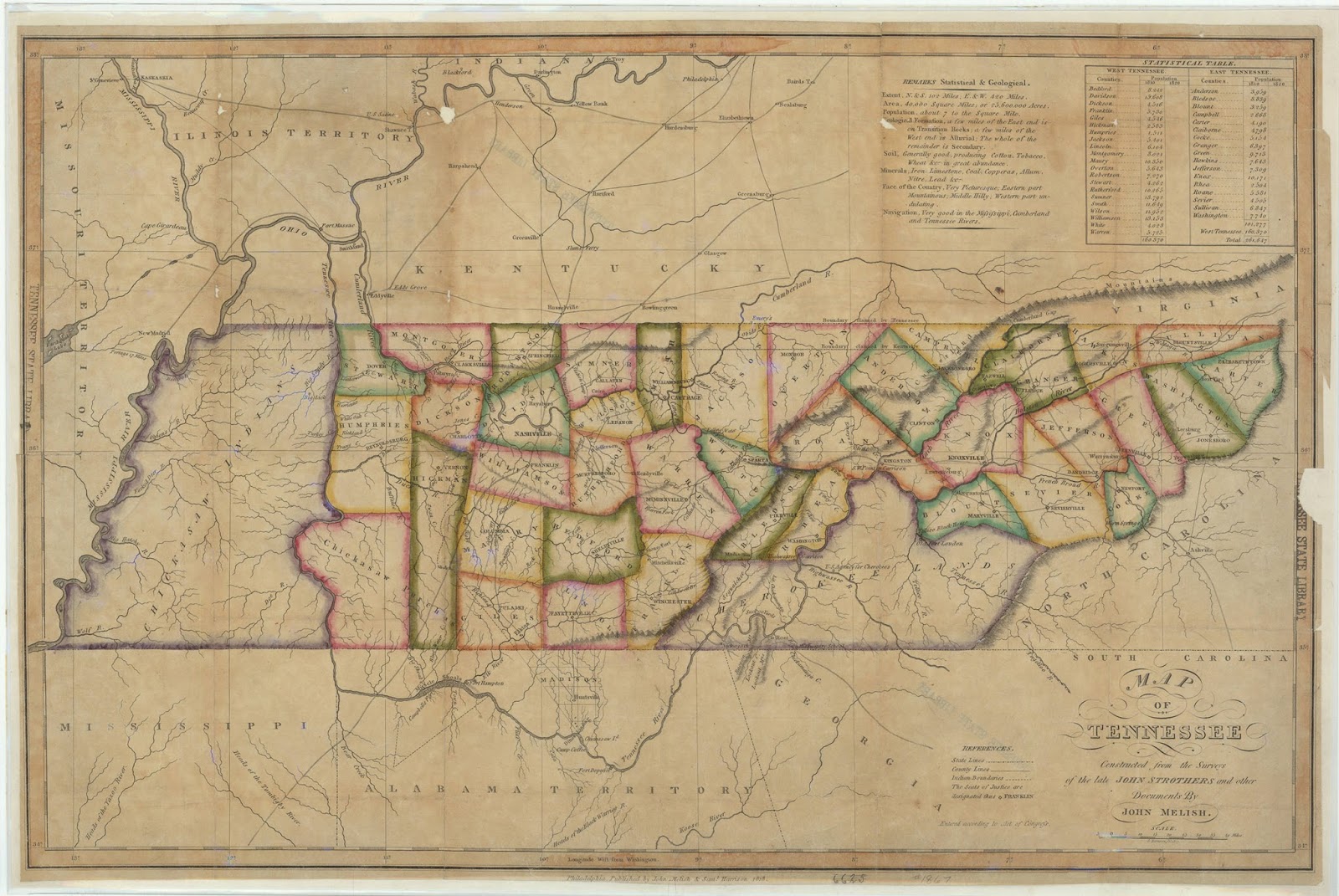
The Evolution of Tennessee's Borders in Maps

It's easy today to think of Tennessee's borders as set in stone, but that hasn't always been the case. Those borders changed repeatedly throughout the early years of the state's history due to land grant settlements, treaties with Native Americans and even changes in the course of the Mississippi River.

To help better understand how Tennessee's borders came to be where they are, map expert Murray Hudson will conduct a free lecture at the Tennessee State Library and Archives (TSLA) Aug. 15. Hudson, the owner and proprietor of Antiquarian Books, Maps, Prints & Globes in the West Tennessee community of Halls, will take lecture participants on a journey that begins along North Carolina's colonial borders, travels through the “Lost State of Franklin,” documents the annexation of Cherokee and Chickasaw territory, highlights western border changes brought about by shifts in the Mississippi River and describes Supreme Court decisions that seem to have finalized Tennessee's state boundaries.

The lecture will be held from 1:30 p.m. until 3 p.m. Aug. 15 at TSLA's auditorium in downtown Nashville. Although it is free and open to the public, reservations are required because seating in the auditorium is limited. To reserve a spot at the workshop, visit: http://tnmaps.eventbrite.com

The lecture is being conducted to highlight "Find Your Path," a free exhibit of historical maps currently on display in TSLA's lobby. The exhibit will be available for inspection until September during TSLA's normal operating hours, from 8 a.m. until 4:30 p.m. Tuesdays through Saturdays.

Hudson began collecting antique maps during a summer graduate course at Oxford University in England in 1964. After teaching college, trading stocks, manufacturing bicycle trailers and farming, he turned his map collecting passion into a book and map business in 1979. Hudson used worldwide connections to create what are now three galleries of antique books, maps, prints and globes in Halls. Major institutions around the nation and here in Tennessee have his rare books, maps and prints. His galleries house 30,000 antique books, maps and prints, as well as a huge selection of American-made globes and many foreign globes.

TSLA's building is located at 403 Seventh Avenue North, directly west of the State Capitol building in downtown Nashville. Parking is available in the front, on the side, and in back of the building.

The State Library and Archives is a division of the Tennessee Department of State and Tre Hargett, Secretary of State.

Friday, July 17, 2015

Amputees in the Civil War: Book Details the War's Gruesome Aftermath

The Civil War wreaked havoc across the North and the South. Families were torn apart, fortunes were lost, national morale was at an all-time low - and even seemingly minor gunshot wounds could have devastating consequences. Often, surgeons had to amputate relatively intact limbs because the patients were at risk for infection from the shrapnel and unsterilized conditions.

A page from The Medical and Surgical History of the War of the Rebellion (1861-65) depicting "Amputations at the Ankle Joint." Library Collection. Tennessee State Library and Archives.


The Tennessee State Library and Archives' holdings include Empty Sleeves: Amputation in the Civil War South, a book by Brian Craig Miller that details how both individuals and the unstable state governments in the Confederacy handled amputations during and after the Civil War. With so many amputations near the beginning of the war, surgeons were sometimes referred to as “butchers.” By the end of the war, regulations and surgical practices had improved, which considerably lowered the number of amputations performed. Nonetheless, thousands of men and their families were left with losses that impacted their finances and their emotional states.


View of the front and side of Crutchfield House, located in Chattanooga, Tennessee. This building served as a post headquarters and hospital during the Civil War. Library Photograph Collection.

Empty Sleeves is just one of several resources held at the Tennessee State Library and Archives that cover medical practices during the Civil War. Other sources include:

  • Medical and Surgical History of the War of the Rebellion (published in six parts) U.S. Surgeon General, (Washington: Govt. Printing Office 1870-1888.) Index published 1992. Case studies written by military surgeons detailing treatment of wounds and sickness. The majority are for Union soldiers, with a fair complement of Confederates. The three-volume index is a recent publication and can be searched by soldier's name or unit.
  • Samuel Hollingsworth Stout Papers, 1819-1963. Stout served as the Director of Hospitals for the Army of Tennessee, CSA from 1863 to 1865. The correspondence and documents within this manuscript collection reveal hospital administration techniques and military field conditions of the Confederacy in the western theater of the Civil War. There are many other manuscript collections which describe medical conditions in the Civil War just waiting to be discovered at the Tennessee State Library and Archives.


To learn more, we invite you to explore these titles and other collections held in our collection. The State Library and Archives is open to the public Tuesdays to Saturdays, 8:00 a.m. until 4:30 p.m. CT.


The State Library and Archives is a division of the Tennessee Department of State and Tre Hargett, Secretary of State.