Wednesday, February 7, 2018

Black Combat Units of World War I

By Allison Griffey

During World War I, options were limited for black men who enlisted or were conscripted into the military. The Army was segregated; only white men were allowed to serve in the Marines; and the Navy and Coast Guard offered only low level, unskilled positions to black men. The majority of African American men in the military served in non-combat positions such as stevedores, and some of these men were regularly exposed to the dangers of the front lines despite the fact that they were unarmed.

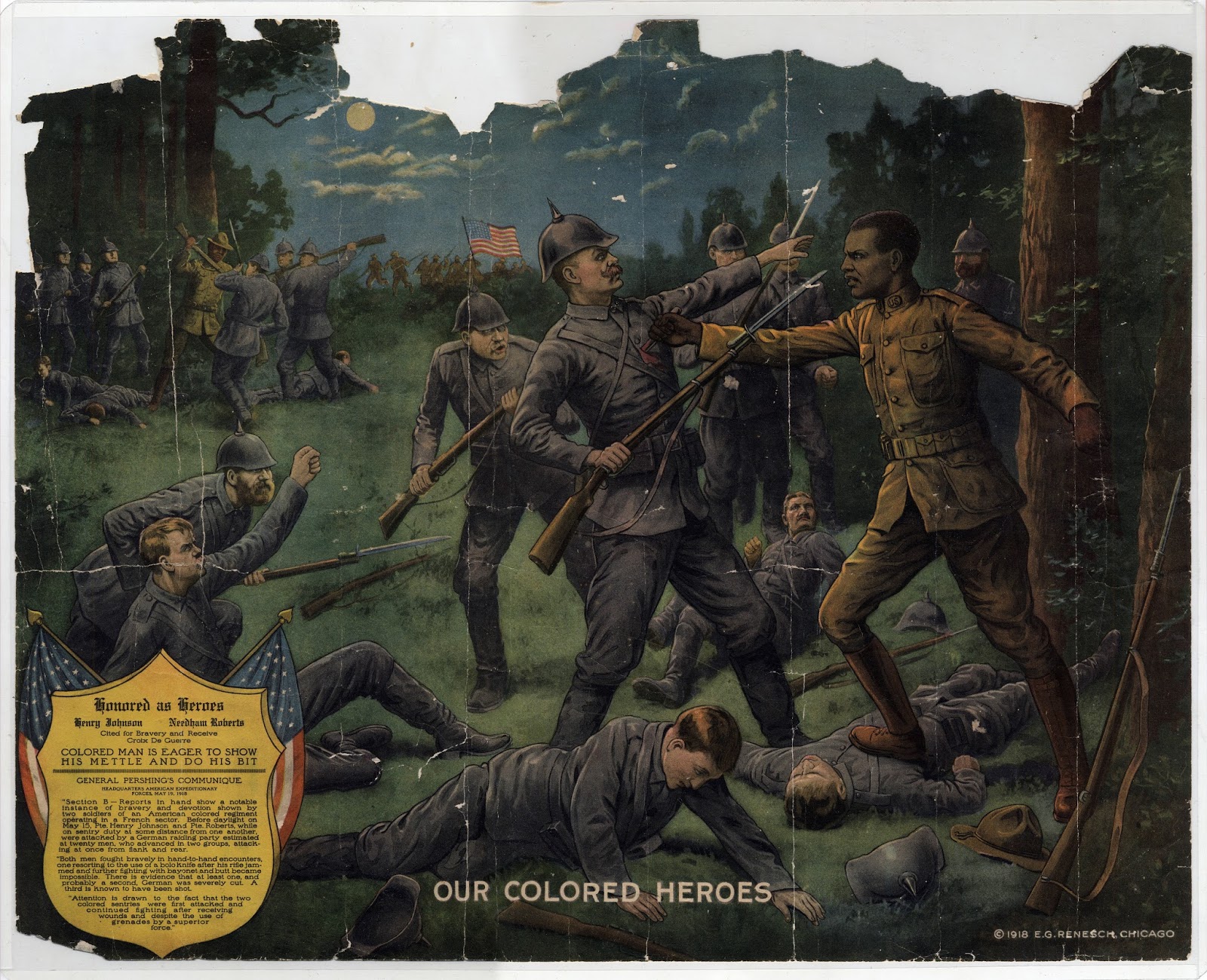
“Our Colored Heroes” was published in 1918 to celebrate the bravery of Sgt. Henry Johnson and Pvt. Needham Roberts of the 369th Infantry Regiment, 93rd Division who defended themselves against at least 12 German soldiers during a raid. Sgt. Johnson managed to defend himself and save Pvt. Roberts using hand-to-hand combat and a knife and saved both men from becoming prisoners of war. Sgt. Johnson was posthumously awarded the Medal of Honor for this courageous act in 2015.
Source: http://teva.contentdm.oclc.org/cdm/singleitem/collection/p15138coll18/id/2332/rec/1


The only combat divisions for black men at the time were the 92nd and 93rd Divisions. The 92nd Division, also known as the “Buffalo Soldiers Division,” was composed of drafted men from all over the United States. Most of the men in the 93rd Division were members of National Guard units in Connecticut, the District of Columbia, Illinois, Maryland, Massachusetts New York, Ohio and Tennessee or men drafted from South Carolina.

Service abstract of Pvt. John Tender of Union City, TN. He was a member of Co D, 369th Infantry Regiment, 93rd Division was severely wounded in action around October 20, 1918. The men of the 369th Infantry Regiment are famously known as the “Harlem Hellfighters” because the majority of the men in this regiment came from the militarized New York National Guard 15th New York Infantry Regiment.
Source: http://teva.contentdm.oclc.org/cdm/compoundobject/collection/p15138coll38/id/6026/show/5991/rec/7


Black men in these combat divisions, like Sgt. Henry Johnson and Pvt. Needham Roberts of the 93rd Division, were initially celebrated for their heroic feats, but their fame faded quickly. A century later, these men are two of the most famous servicemen to fight in World War I. At this time, only two African American men have been awarded the Medal of Honor for their World War I service: Cpl. Freddie Stowers and Sgt. Henry Johnson, both of the 93rd Division. There are doubtless many other black servicemen whose stories of bravery are waiting to be told.

Photograph from the Gold Star Record of Pvt. Jim Granberry of Mt. Pleasant, TN. He was a member of Co L, 368th Infantry Regiment, 92nd Division was killed in action on September 29, 1918, during the Meuse-Argonne Offensive. Due to strictly enforced segregation during training and military official rivalries, the 92nd Division was given little to prepare them for their role in this offensive, especially the men of the 368th Infantry Regiment.
Source: http://teva.contentdm.oclc.org/cdm/compoundobject/collection/p15138coll26/id/4860/rec/2


The Library and Archives holds gold star records for black servicemen who died during the war, as well as service abstracts for black Tennesseans who served during the war.


The Tennessee State Library and Archives is a division of the Office of Tennessee Secretary of State Tre Hargett

Tuesday, February 6, 2018

Obion River Regional Library Hosts 2018 Legislative Day

Representatives from nine West Tennessee counties gathered in Martin Feb. 2 to discuss a range of issues affecting the state’s public libraries. The event was organized by the Obion River Regional Library, which is part of the Tennessee State Library and Archives.

Attendees included Sen. Ed Jackson (R-Jackson) as well as many county and city mayors from across the region.

The meeting included a briefing by Tennessee State Librarian and Archivist Chuck Sherrill about the need for the continuation of state dollars for the completion of a new Library and Archives building in Nashville. The modern facility will be co-located with the Tennessee State Museum on the Bicentennial Mall creating synergies for visitors and school groups.

“I think this was a very productive meeting. Each year, the Tennessee Library Association hosts Library Legislative Day in Nashville while the General Assembly is in session. This year’s event is scheduled for March 14. While Library Legislative Day helps secure important library support from the state, most public library funding comes from counties and cities,” Sherrill said. “Holding events like these in the communities served by our local libraries get to the heart of what makes libraries important anchor institutions. I hope everyone who attended this event took away some useful information.”

The meeting also included a discussion of the importance of providing broadband internet access at libraries and the funding requirements city and county governments must meet in order to keep their libraries in compliance with state standards. The “Return on Investment” for each library was also highlighted as just one means of assessing the impact of public libraries on the communities they serve.

Photo Lineup - 2018 Library Legislative Breakfast


Benton County -- Left to right: Don Farmer, Chairman, Obion River Regional Library Board; Mary Lou Marks, Benton County Library Board; Alvin Smothers, Benton County Library Board; Senator Ed Jackson, District 27; Chuck Sherrill, Tennessee State Librarian & Archivist.

Carroll County -- Back row left to right: Don Farmer, Chairman, Obion River Regional Library Board; Jean Alexander, Director, McKenzie Memorial Library; Reggie Lawrence, Obion River Regional Library Board; Senator Ed Jackson, District 27; Chuck Sherrill, Tennessee State Librarian & Archivist. Front row left to right: Beverly Miller, McKenzie Memorial Library; Nikki Cunningham, Director, Carroll County Public Library; Mona Batchelor, Obion River Regional Library Board.

Dyer County -- Left to right: Robert Ell Hurt, Obion River Regional Library Board; Don Farmer, Chairman, Obion River Regional Library Board; Sylvia Palmer, Obion River Regional Library Board; Kathryn McBride, Director, McIver’s Grant Public Library; Lee Weakley, President, McIver’s Grant Public Library Board; Senator Ed Jackson, District 27; Chuck Sherrill, Tennessee State Librarian & Archivist.
 
Gibson County -- Back row left to right: Don Farmer, Chairman, Obion River Regional Library Board; Lindsey Ingram, Director, Gibson County Memorial Library; Dr. Beverly Youree, Obion River Regional Library Board; Senator Ed Jackson, District 27; Chuck Sherrill, Tennessee State Librarian & Archivist. Front row left to right: Kay Pounds, President, Gibson County Memorial Library Board; Missy Blakely, Director, Mildred G. Fields Memorial Library; Alderwoman Tammy Wade, Milan.

Henry County -- Left to right: Don Farmer, Chairman, Obion River Regional Library Board; Mayor Brent Greer, Paris; Connie McSwain, Director, W.G. Rhea Public Library; Susan Pemberton, Obion River Regional Library Board; Senator Ed Jackson, District 27; Chuck Sherrill, Tennessee State Librarian & Archivist.

Lake County -- Left to right: Don Farmer, Chairman, Obion River Regional Library Board; Dr. Robert Shull, Obion River Regional Library Board; Senator Ed Jackson, District 27; Mayor Denny Johnson, Lake County; Chuck Sherrill, Tennessee State Librarian & Archivist.
 
Obion County -- Back row left to right: David Searcy, Obion County Public Library Board; Mayor Benny McGuire, Obion County; Senator Ed Jackson, District 27; Chuck Sherrill, Tennessee State Librarian & Archivist.

Front row left to right: Don Farmer, Chairman, Obion River Regional Library Board; Ellarine Moses, Obion River Regional Library Board; Carolina Conner, Assistant Director, Obion County Public Library; LeEllen Smith, Obion County Public Library Board; Michele Barnes, Director, Obion County Public Library; Mike Cox, Obion River Regional Library Board.

Weakley County -- Back row left to right: Deena Smith, Director, Sharon Public Library; Joyce Haworth, Sharon Public Library Board; Jerry Swaim, Dr. Nathan Porter Memorial Library Board; Senator Ed Jackson, District 27; Chuck Sherrill, Tennessee State Librarian & Archivist.

Middle row left to right: Don Farmer, Chairman, Obion River Regional Library Board; Mary Ellen Harris, Sharon Public Library Board; Faye Kendall, Sharon Public Library Board; Lynn Alexander, C.E. Weldon Public Library Board; Mayor Cindy McAdams, Greenfield; The Honorable Tommy Moore, Obion River Regional Library Board; David McAlpin, Ned R. McWherter Weakley County Public Library Board; Jim Phelps, Gleason Public Library Board.

Front Row left to right: Nancy Hinds, Obion River Regional Library Board; Candy McAdams, Director, Ned R. McWherter Weakley County Public Library Board; Mike Rea, C.E. Weldon Public Library Board; Judy Paschall, Director, Gleason Public Library Board; Mayor Diane Poole, Gleason; Patsy Ezell, Gleason Public Library.
 
Library Directors -- Back row left to right: Don Farmer, Chairman, Obion River Regional Library; Deena Smith, Sharon Public Library; Candy McAdams, Ned R. McWherter Weakley County Public Library; Lindsey Ingram, Gibson County Memorial Library; Senator Ed Jackson, District 27; Chuck Sherrill, Tennessee State Librarian & Archivist; Michele Barnes, Obion County Public Library.

Front row left to right: Kathryn McBride, McIver’s Grant Public Library; Jean Alexander, McKenzie Memorial Library; Connie McSwain, W.G. Rhea Public Library; Missy Blakely, Mildred G. Fields Memorial Library; Nikki Cunningham, Carroll County Public Library.
 
Obion River Regional Board -- Back row left to right: Don Farmer, Chairman, Obion River Regional Library; Alvin Smothers, Benton County; Robert Ell Hurt, Dyer County; Reggie Lawrence, Carroll County; Dr. Beverly Youree, Gibson County; Senator Ed Jackson; Chuck Sherrill, Tennessee State Librarian & Archivist; The Honorable Tommy Moore, Weakley County; Dr. Robert Shull, Lake County; Sylvia Palmer, Dyer County; Mike Cox, Obion County.

Front row: Nancy Hinds, Weakley County; Mona Batchelor, Carroll County; Mary Lou Marks, Benton County; Susan Pemberton, Henry County; Ellarine Moses, Obion County; Mary Carpenter, Director, Obion River Regional Library.


The Tennessee State Library and Archives is a division of the Office of Tennessee Secretary of State Tre Hargett

Friday, February 2, 2018

Tennessee State Legislative Records shed historical light on Reconstruction

By Caleb Knies

The U.S.’ Reconstruction Era following the Civil War (1860-1865) is a historical quandary; black Americans experienced freedom from enslavement, opportunities for economic and social growth, but white insecurity over this freedom saw the development of de facto and de jure Jim Crowism, creation of the KKK and start of a new chapter in the nation’s painful and complicated race relations. So many opportunities opened and explored, yet so much violence and hate; it is easy to understand why there is much debate over this important, but melancholy era in American history. The social and cultural atmosphere of the era was abuzz with excitement tinged with fears and memories of violence, and at the center of it all, at least for a while, was Tennessee’s General Assembly.

Horace H. Harrison used this ticket to vote for the abolition of slavery Feb. 22, 1865. A handwritten note on the back reads: "Copy of a ticket I voted on the 22nd of Febry 1865 to ratify the amendment to the state constitution abolishing slavery in the State of Tennessee. Horace H. Harrison."
Joseph Branch O’Bryan Papers, Tennessee State Library and Archives


After abolishing slavery, by adopting the 13th Amendment to the United States Constitution, Tennessee’s state legislature set the stage, both locally and nationally, for the Reconstruction Era following the Civil War. State Congressional sessions are quite common-place, yet few maintain the historical gravity of Tennessee’s 34th General Assembly. To begin there are two distinct 34th General Assemblies in Tennessee, the 34th Assembly under Confederate rule (1861-1862) and another one, stemming from the first postwar elections in 1865, under Union control.

J. C. Buttre engraving of Governor William G. Brownlow, Governor of Tennessee 1865-1869.
Photograph Collection, Tennessee State Library and Archives


Governor Brownlow called multiple special sessions from 1866-1867, one in July 1866 to ratify the 14th Amendment to the United States Constitution making Tennessee eligible for readmittance to the Union, well before the rest of the former Confederate states. The 14th Amendment redefined citizenship, included the Equal Protection Clause - that no state shall deny equal protection of the laws to its citizens, applied the Due Process Clause to states - granting equal legal process to all citizens, and included a now-dormant Privileges or Immunities Clause - preventing states from making and enforcing laws which abridge the privileges and/or immunities of citizens of the United States. However, issues arose when so few Representatives showed up that quorum was not reached and the Senate adjourned until attendance minimums were met. It also helped that before adjourning, the Senate gave the OK to Governor Brownlow to issue arrest warrants for absent Representatives. After reaching a quorum, the General Assembly passed the 14th Amendment to the Constitution and dismissed July 24, 1866; just in time to be recognized by the federal Congressional session which opened July 26, 1866.

Excerpt from House Bill 138, June 5, 1865: A bill to limit the elective franchise.
Record Group 60, Tennessee State Legislative Records, Tennessee State Library and Archives


 Another significant issue facing Tennessee’s 34th Union General Assembly was the matter of dismantling the Confederate political machinery, namely through the passage of franchise law amendments, attempts to “grant voting privileges to some and remove it from others.” While the wording is vague, it seems the intent of the General Assembly was to grant black male Tennesseans the right to vote, while denying the voting privileges of those who supported and fought for the Confederate States of America. There are two-years of materials in our Legislative Records Collection (known as RG60) from this state legislature concerning the right to vote - known as the elective franchise. The first, a bill from the 34th Union Assembly in 1865 which limited the vote to loyal citizens; to the last, a resolution in 1867 still tweaking the verbiage of the new voting laws. Toward the end of the third session, a four-part resolution was passed that faced little challenge in remaining weeks. House Joint Resolution 349 took a four-step approach to ensuring black males were allowed to vote and hold office in Tennessee. HJR349 eliminated the word “white” from the voting sections and changed other discriminatory sections of the state constitution, struck the state’s Franchise Law, and forced the refinement and publication of the new Constitution, this one featuring voting rights for African-American men, two years before federal Franchise Laws.

An illustration from the Nov. 16, 1867, edition of Harper’s Weekly depicting a queue of African-American men waiting to cast their vote while the first man is voting.
Manuscripts Oversize Files, Tennessee State Library and Archives


Foreshadowing some of the violence that would continue well-after Reconstruction, there was a murder during the winter break of the 34th Assembly. Hon. Dr. Almon Case, Senator from Obion Co., was shot in the road outside of his home in the middle of January 1867. Still grieving the murder of his son a few days prior, Case was shot and killed by Frank Ferris, Confederate loyalist. Newspapers of the day highlighted the growing split between Unionists and those still loyal to the Confederate cause; the Nashville Press & Times focused on Cases’ Unionist reputation as motivation for murder, while the Conservative (i.e., Confederate-loyal) Memphis Daily Avalanche cited Farris’ motivation was retaliation for the death of his brother during the war. Either way, it was clear, the emotions, pain, and violence of the war would continue. Ironically, before his death, Dr. Case pushed the state for universal amnesty and enfranchisement and had helped the Ferris family before the war.

Senate Resolution 20, Jan. 24, 1867: “we have heard with deep regret of the untimely death of the Hon. Almon Case, a Member of this Body, Therefore Be it Resolved by the Senate that a Committee of three be appointed by the Speaker of the Senate to draft Suitable Resolutions expressive of our high regard for the Deceased and Sympathy with his family.”
Record Group 60, Tennessee State Legislative Records, Tennessee State Library and Archives


Rarely does one session of a state Congress get to handle so many hot-button topics, but when the impetus is to reunite a nation and reorganize a state, there are no topics too controversial or too challenging to be faced. The whole focus of Tennessee’s 34th General Assembly was to re-establish a functional, working government that sought to create freedoms for its people. If you are interested in researching legislation from the 34th General Assembly, check out our online index here: http://tnsos.net/TSLA/rg60/


The Tennessee State Library and Archives is a division of the Office of Tennessee Secretary of State Tre Hargett

Tuesday, January 30, 2018

Library and Archives Releases the Price-Gay Family Papers

By Patricia Mitchell

What remains of a life lived? A cigar, a ticket stub, a well-worn letter? What stories might these possessions tell of our families, our homes and our life’s work? Explore these questions and more with the Tennessee State Library and Archives’ recently processed Price-Gay Family Papers. Originating from Andrew Price (1854-1909) and his wife Anna Gay (1855-1939), these materials consist of documents, photographs, and artifacts that capture family life, real estate matters, and politics in the United States for the years 1822 to 1944.

Martha and Edward at Clover Bottom Mansion, Donelson, Tenn., 1899 August.
Price-Gay Family Papers, 1822-1944, Box 18, Folder 7
Tennessee State Library and Archives


Much of the collection concerns Acadia Plantation, the Prices’ sugar plantation in Lafourche Parish, Louisiana. These materials include several photographs of the interior of the plantation house as well as numerous photographs of the exterior and interior of the sugar refinery on-site.

Other contents relate to Clover Bottom Farm in Donelson, Tennessee, where Andrew Price bred, raised and trained trotting horses. Here researchers will uncover a number of studbooks, sale records, clippings, and a scrapbook on the subject. Also included are photographs that provide a rare look at the sprawling estate and the staff who made it thrive.

Brochure for dispersal sale of trotting horses at Clover Bottom Farm, 1909 May 12.
Price-Gay Family Papers, 1822-1944, Box 11, Folder 17
Tennessee State Library and Archives

Season admission ticket books to the Tennessee Centennial Exposition for Anna Gay Price, 1897.
Price-Gay Family Papers, 1822-1944, Box 1, Folder 3
Tennessee State Library and Archives

Parlor at Clover Bottom Mansion, Donelson, Tenn., 1918 May 14.
Price-Gay Family Papers, 1822-1944, Box 18, Folder 5
Tennessee State Library and Archives


Edward Hill and "Dewey" at Clover Bottom Mansion, Donelson, Tenn., 1898 December 11.
Price-Gay Family Papers, 1822-1944, Box 18, Folder 7
Tennessee State Library and Archives


In addition to his horse breeding operation, Andrew Price served as a U.S. Representative from 1889-1898. Two "goldbug" pins from William McKinley's presidential inauguration in 1897 will transport researchers to this tumultuous period in American politics, when Price joined other conservative Democrats to defend the gold standard against the rising tide of Silver Populists.


Mrs. Andrew Price purchased these bugs on Pennsylvania Avenue Washington, DC 1897 at the time of the Inauguration of President William McKinley.
Price-Gay Family Papers, 1822-1944, Box 30, Item 5 and Box 14, Folder 1 respectively.
Tennessee State Library and Archives


Perhaps most intriguing, however, is the human drama of personal relationships revealed in the collection’s correspondence. If Anna Gay were here in the present, she would tell you that before her engagement to Mr. Price in 1878, she had many admirers (and the receipts to prove it). All of the correspondence written between 1873 and 1878 either came from prospective suitors or her girlfriends discussing her suitors. Other documents in the collection relay the goings on of a typical 19th century family and the scandals of its black sheep.

Edwin Booth and Edwina Booth, ca. 1864. Edwin Booth (1833-1893) was an actor and the brother of John Wilkes Booth. Edwina Booth (1861-1938) was Edwin's only daughter.
Price-Gay Family Papers, 1822-1944, Box 30, Item 5 and Box 14, Folder 1 respectively.
Tennessee State Library and Archives


We welcome you to visit the Tennessee State Library and Archives to research this rich source of historical materials. We hope to digitize parts of the collection for inclusion in the Tennessee Virtual Archive and will announce their online availability at a later date. For more information on the contents of this collection, please see our finding aid here.


The Tennessee State Library and Archives is a division of the Office of Tennessee Secretary of State Tre Hargett

Thursday, January 25, 2018

Library and Archives Hosts Free Workshop on African-American Family Research

Connecting families with records that tie them together is often a barrier in African-American research. On Feb. 17, the Tennessee State Library and Archives will host a free workshop on African-American genealogy.

Family portrait of Henry W. Allen, Catherine B. Allen, and Minta B. Allen. Daybook entry under Mrs. H. W. Allen.
Calvert Brothers Studio Glass Plate Negatives
Tennessee State Library and Archives


Patrons will watch Discovering the Missing Threads and Patches in my Family’s History: A Pre-recorded Webinar and Discussion featuring Deborah Abbott, Ph.D. Abbott is a professional genealogist who specializes in advanced African-American research, manuscript collections and genealogy methodology. She has also been highlighted on various projects with Ancestry.com.

"Anyone interested in their family's history can find a wealth of information at the Library and Archives. I'm honored this workshop will highlight the collections and records available to the public that traces African-American history in Tennessee," said Secretary of State Tre Hargett.

Dr. Deborah Abbott, Ph.D.
Abbott will highlight how genealogists shouldn’t ignore the basics. Her webinar demonstrates how to understand all records and the history that surrounds them which can bridge the gap between slavery and freedom.

Certified genealogist and fellow of the Utah Genealogical Association, J. Mark Lowe, will moderate the discussion.

The workshop will be 9:30 a.m. until 11 a.m. CST Saturday, Feb. 17, in the Library and Archives auditorium.

The Library and Archives is located at 403 Seventh Ave. North, directly west of the Tennessee State Capitol in downtown Nashville. Free parking is available around the Library and Archives building. Although the workshop is free and open to the public, registration is required due to seating limitations in the auditorium. To reserve seats, please visit https://abbottworkshop.eventbrite.com.


The Tennessee State Library and Archives is a division of the Office of Tennessee Secretary of State Tre Hargett

Thursday, January 18, 2018

Meet the Staff - Megan Spainhour

Meet Megan Spainhour. She is a Digital Imaging Specialist with the Digital Work Group.

How long have you worked here?

Since September 2013.

What are some of the things you do as a Digital Imaging Specialist?

I work fulfilling both patron and internal orders. This typically means scanning, printing and preparing maps, photos, letters, and many other items that are requested from our collections. I work with authors, publishers, researchers, genealogists, filmmakers, and several other types of patrons who are interested in obtaining copies of images in either digital or print form. Orders that I receive can vary from working with microfilm to printing out large maps, sometimes up to 5 feet. I also assist as a staff photographer and organize our group’s “Learn The Collections” program, in which each of us in the Digital Work Group is assigned a random collection every two weeks to learn and present to the rest of the group.

What is your favorite part of your job?

Learning history. I moved to Tennessee in 2010, and really didn’t know that much about the state’s history before I worked at the Tennessee State Library and Archives. I learn so much every day and to be able to hold and see original items in your hands is both fascinating and amazing. It is easy to put yourself in the shoes of that original creator writing that letter or taking that historical photo. I also love working and communicating with patrons who have struck gold in their research, and have found something they are excited about. I have a lot of fun fulfilling those orders.


Do you have a favorite collection?

With the wide variety of treasures we have here at Tennessee State Library and Archives, I cannot just narrow it down to one. A few of the top favorites are The Grassmere Collection, Genealogical Charts Collection and TSLA Map Collection. Some of my co-workers and I are currently working on a project with the Grassmere Collection, which has an amazing story to tell. I encourage our patrons to visit, pull anything that sounds interesting from our collections, and just learn. You can find some pretty intriguing stories when you have got the time to learn.

What makes libraries and archives relevant to modern society?

History. History will never go out of style. There is always something to gain from researching and learning about our ancestors and our past. They say history repeats itself, which cannot be denied.


The Tennessee State Library and Archives is a division of the Office of Tennessee Secretary of State Tre Hargett

Wednesday, January 10, 2018

Utilizing digital scanners in your research

By Heather Adkins

At the Library and Archives, we strive to stay up to date on the best technology to better serve researchers. This includes three types of scanners that have proven very popular.

Microfilm readers look different today from the crank machines created decades ago. Though we have readers hooked to printers, more often researchers utilize our microfilm scanners. There are several benefits to using scanners rather than printers. Foremost, scanning allows researchers to have a master digital copy without risk of ruining or losing a paper copy. A digital copy also lets researchers send copies to friends and family and print innumerable copies without the cost. Speaking of cost, scanning microfilm to your flash drive is free. Using our printers costs $0.25 per page, which makes scanning more economical. Researchers can utilize digital scanners to scan anything from microfilmed newspaper articles, state records, manuscript collections, county records and vital records.

Tips for using microfilm scanners:

  • Zoom into newspaper articles as far as possible rather than scanning the entire page. If you scan the entire page, the scan may not be high enough resolution to zoom into the article later.
  • If the record has more than one page, you can scan a multipage PDF. Ask a staff member to show you how!


Book scanners get a lot of traffic in the library. Researchers who use our book collection often want to take copies of a few pages home with them. These scanners allow for that: just insert a flash drive and scan – it’s that simple! The book scanners are built with an adjustable bed, designed to relieve pressure on a book’s spine while still allowing for a flat page spread. Like the microfilm scanners, the book scanners are free to use. Using the photocopy machine is $0.15 per page, so again scanning is a better deal. Also, like the microfilm scanners, the book scanners give you a master digital copy.

Not sure what you can scan? We’ve seen all sorts of books scanned – city directories, county record transcripts, atlases and histories. That said, it is the responsibility of the researcher to determine use under copyright. Find out more about that here. [https://sos.tn.gov/products/tsla/use-library-archives-materials]

Tips for using the book scanners:

  • You can adjust page settings before saving the scan to your flash drive. The page borders are adjustable, and you can limit the scan to one page or the entire spread.
  • If you want more than one page from a particular book, you can make a multipage PDF. Ask a staff member to show you how!


Researchers can access both microfilm machines and the book scanners when visiting the Library and Archives. However, there is one more scanner that researchers frequently use without realizing it. The map scanner is a large flatbed machine used by our Digital Work Group (DWG) for researcher requests and programs like Education Outreach, Exhibits and the Historical Maps Digital Collection. To date, DWG has scanned nearly 600 maps of a collection of over 4,000, and they scan about 10 more every month with the help Archival Technical Services and Archives Development Program staff who research and write metadata.

Although DWG does not scan researchers’ personal items, they do take requests for specific collection items. Are you interested in finding a map of where you live or Tennessee as a new state? You can look them up on the Tennessee Virtual Archive (TeVA). Though only a portion of the map collection is currently scanned, you can search through the entirety of the collection here. [https://sos.tn.gov/tsla/maps]

Tips for researching and ordering maps:

  • When searching for maps at the above link, type keywords in the “Search Maps” bar.
  • You can order high-resolution scans or prints of items, and you can also download lower resolution images directly from TeVA.
  • Ready to order a map? There are a couple details that you will need to fill out the order form. Please include either the ID# (if there is an image available online) or the Location (if there is NOT an image available online). The ID#, location and other descriptors are available in the metadata for each map.


Scanners accessible by the public save to flash drives. If a researcher forgets theirs, we provide flash drives at our cost to purchase them as a service to our visiting researchers. Have a question about how to use the scanners? Our Public Services staff is here to help. We’ll get you scanning records in no time!


The Tennessee State Library and Archives is a division of the Office of Tennessee Secretary of State Tre Hargett