Tuesday, April 3, 2018

New Language Learning Resource Now Available to Tennessee Residents Free Through TEL

Tennessee residents can now access a new language learning resource for free through the Tennessee Electronic Library.

Transparent Language Online (TLO) is an innovative language learning system for learners of all levels looking to build their listening, speaking, reading and writing skills. TLO is packed full of pronunciation, speech, grammar, writing and vocabulary building lessons. With over 100 languages to choose from, including English for non-native speakers in over 26 languages, there is something for every learner, including children! Kidspeak is a fun, easy to use language learning program for ages six and up, available in Chinese, English, French, German, Italian and Spanish. Learners can access TLO anywhere - at home, in the library or on the go at any time. Sign up for a free account and start learning!

Which languages are included in Transparent Language?

https://home.transparent.com/transparent-language-online-available-languages

Learn a new alphabet: Full-length alphabet courses are available for 18+ languages to familiarize you with new writing systems, including Mandarin Chinese, Hindi and Arabic.


Essentials Courses: These courses guide you through 30+ lessons of language fundamentals, including meeting and greeting, expressing wants and needs, planning for a trip, dealing with money, asking for help and beyond.


Supplemental Vocabulary: Hundreds of vocabulary lists will teach you thousands of new words and phrases through a completely redesigned suite of fun, interactive activities.


Start learning a new language using Transparent Language today by visiting your local library website or TEL at http://tntel.info/.


The State Library and Archives is a division of the Tennessee Department of State and Tre Hargett, Secretary of State

Monday, April 2, 2018

From the Tennessee Supreme Court Case Files... The Theory of Superposition of History

By Caleb Knies

Too often the thought is to first “make” the history without understanding or appreciating the theories that guide well-crafted, balanced and fulfilling definitions of history. Bits of historical evidence, like Supreme Court records, photographs, even things as unexpected as landscapes, soundscapes and most other quanta of historical data are used as evidence to support a particular historian and the narrative he or she is weaving; However, those same items of historical quanta can also be used to evidence new theoretical constructs. Searching for evidence to support a new historical theory can be taxing, however, on occasion, a bit of evidence fits the model so adeptly it is impossible to stifle. A letter drafted by Lytle “Boss” Bingham, connected to four Supreme Court records, is that piece of evidence.

On the dark and snowy night of Jan. 14, 1931, Lytle “Boss” Bingham, cashier at the Hardin Co. Bank, phoned his assistant and brother, James “Jiggs” Bingham, telling him to withdraw all cash-on-hand at the bank and bring it to Boss’s home. The state bank examiner was coming the 15th or 16th, and Boss needed to make sure the cash was deposited with the Federal Bank in Jackson. Boss left home in Saltillo around 9 p.m. heading toward Jackson on TN 5/US 45. In the early morning hours, a car was heard speeding down the highway. A short time later, a warm glow emanating from the horizon sparked little interest in a farmer, but soon his son would find the cause – a burning car with a body in it. The body, believed to Boss’s, initiated a chain of events that led to the discovery of the letter from Boss on the desk of the bank president and the four state Supreme Court cases for Boss’s insurance payouts.

Somewhat like Boss’s letter, these photos are re-creations of the accident scene where Boss’s burned car was found in the early morning hours of Jan. 15, 1932, with a body inside. The original accident scene “lives” in the superposition history - it both exists and does not exist. It clearly happened, but being in that moment again is impossible. Therefore, crime scene photographs and illustrations seek to re-claim any essence of originality left, but will always fall short of being able to capture the ‘reality’ of the scene. Photograph from Mary L. Bingham v. Modern Woodmen of America, Tennessee Supreme Court Records, Tennessee State Library and Archives.

Boss’s accident occurred on a dark and snowy night, these photographs show no signs of snow. The testimonies from the cases all detail the damage to the car, yet the car in this image is undamaged. A person’s sport coat replaces the lap blanket found intact over the hood of Boss’s car. But, these pictures help us (and the courts) collapse the wave function of Boss’s accident into observable bits of historical quanta/evidence/data/etc. It is the observer then, who creates the particle or wave narrative for the quanta. Photograph from Mary L. Bingham v. Modern Woodmen of America, Tennessee Supreme Court Records, Tennessee State Library and Archives.


Before going much further, it is pertinent to introduce the theory. Quantum history is the growing historical field that uses the theories and principles of quantum mechanics to guide the theories and principles of the historical method. One of the key points of quantum physics and quantum history is the appreciation for the state of superposition. For physicists, this is the state of unmeasured particles - both everywhere and nowhere at once, operating as both individual particles and particle waves (also at once). Measured particles only act as particle or wave depending on the observer, any measurement ends the superposition state which is known as “collapsing the wave function.” For quantum historians, history exists in superposition. It is both alive and dead, past and present, yours and mine, ours and theirs - all at once, all in superposition; However, measuring history, like measuring photons, collapses the wave function and bends history to the want of the observer/historian. Unless, as is thought to be the case with the letter, observation/measurement is impossible.

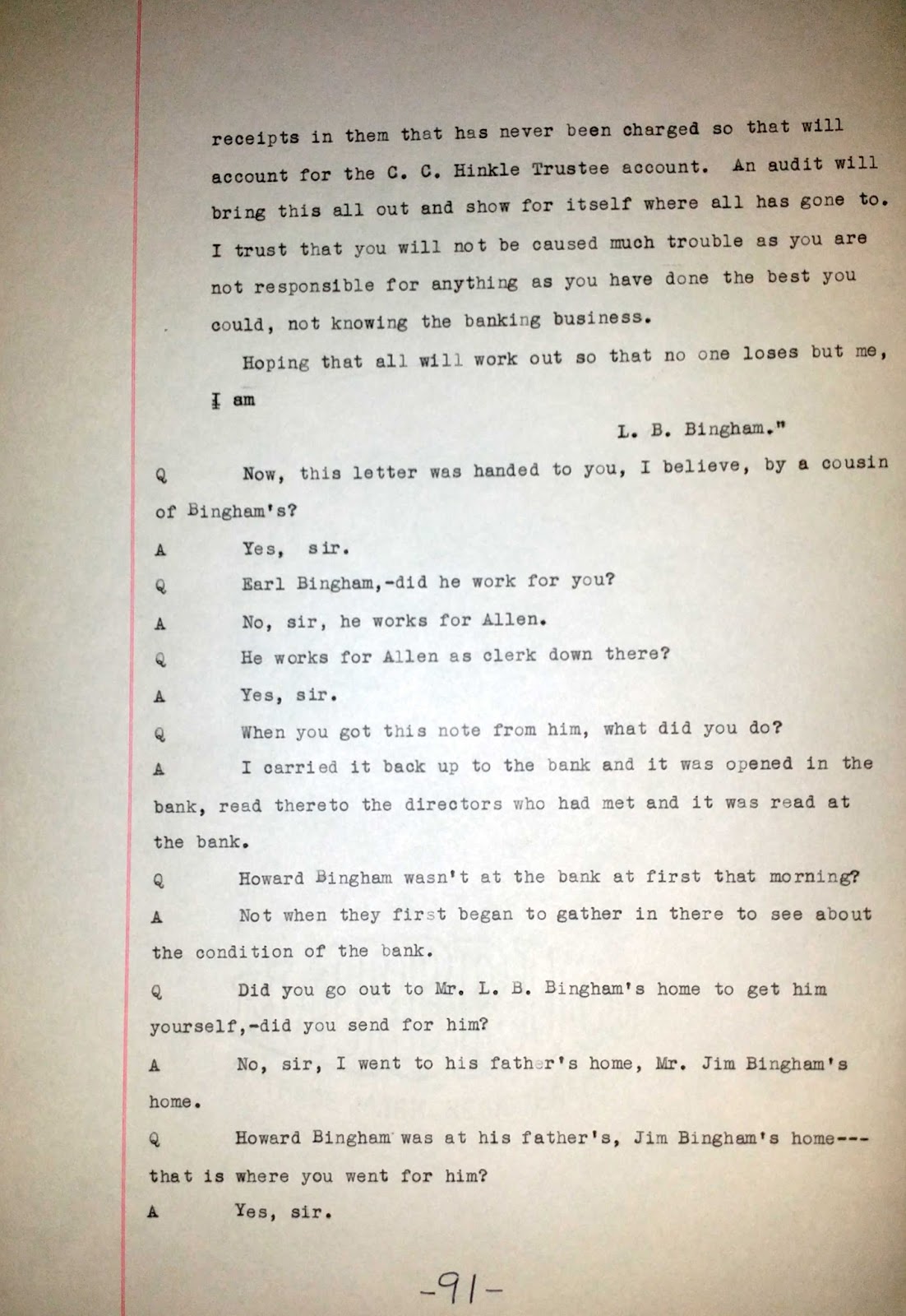
Boss’s letter lives only in historical superposition. The physical letter is missing from the historical record, but the text is held within witness testimony of three state Supreme Court cases (mentioned in the testimony of the fourth, but the actual text of the letter was not entered as evidence). The letter “exists” in the fact that it was a verified piece of evidence in a state court case, and the text of it was entered as testimony in the case; however, the letter itself as mentioned, does not exist. Boss’s letter both exists and does not exist, depending on how “existing” is appreciated and understood by the observer. Interpreting Boss’s letter as either existing or not collapses its wave-function and eliminates its state of superposition.


This is the text of the note written by Lytle “Boss” Bingham to his boss at the Hardin County Bank. The note was found the morning a body, many thought to be Boss’s, was found burning in a car outside of Saltillo. The note itself is missing, but the text was entered into Supreme Court records through the testimony of Dr. L. A. Parker, president of the Hardin County Bank, and finder of the note in question. Image from Mary L. Bingham v. Modern Woodmen of America, but the text also appears in Mary Bingham v. Business Men’s Assurance Co. of America and Verna Bingham, guard. v. Business Men’s Assurance Co, Tennessee Supreme Court Records, Tennessee State Library and Archives.


This ephemeral state of superposition adequately describes the aforementioned letter, and the whole of historical data. It shows that the observer is in control of the outcome of the evidence, to control the outcome of the historical narrative. The historical observer “measuring” historical quanta collapses his or her wave function(s) into existing as either “particle” or “wave.” Erwin Schrödinger was one of the foremost quantum physicists, actively creating, researching and developing the field long before many others even accepted its findings. Well-known, but misremembered, his cat/box paradox was a thought experiment to show the absurdity of quantum physics. Despite memetic errors, it still functions as an appropriate model for understanding how Boss’s letter, and all of history, “lives” in superposition until measured/observed by us, those seeking to interpret its information.

On one hand, the letter may be understood to not exist; the historical implications for that allow for a distinct narrative in which word-of-mouth, oral histories, and the like might fill the gap of the nonexistent letter and create a history where the meaning comes from some of the gaps in the narrative. On the other hand, the letter could be understood as existing; which creates a different narrative than a nonexistent letter, because the evidence is interpreted differently by the observer. The implications for this interpretation may be a disregard for the context surrounding the note and taking it at face value, a reliance on “factual” history and creation of historical narratives where evidence is assumed unquestionable. While interpreting the letter as either existent or not is a minor part of the larger whole of Boss’s story, the way historians interpret historical evidence deeply matters to the histories we use, create and assemble. Not unlike scientific quantum physics, Quantum History analysis can adopt and adapt the thought experiment to analyze itself and historical information.

One of the deeply intriguing collections at the Tennessee State Library and Archives is the Tennessee Supreme Court Records, home to all of the cases heard by the state Supreme Court. Scores of records (due to volume only 19th and early 20th century cases) are cleaned, folded, and ready for the public - with more added daily. The Tennessee Supreme Court Records includes cases concerning debt owed on livestock purchases, land and title debates, murders and even insurance suits. Four cases out of the many thousands held at the Library and Archives revolve around the mysterious disappearance and supposed death of Lytle “Boss” Bingham. While the full details of the Bingham cases warrant their own forthcoming blog post, a key piece of evidence in the trial is also the key piece of evidence for understanding a new historical theory.

If you are interested in researching Tennessee Supreme Court cases, check out our online index: http://sos.tn.gov/products/tsla/tennessee-supreme-court-cases.


The Tennessee State Library and Archives is a division of the Office of Tennessee Secretary of State Tre Hargett

Thursday, March 29, 2018

Library for the Blind and Physically Handicapped Gets New Name


The Tennessee Library for the Blind and Physically Handicapped is now the Tennessee Library for Accessible Books and Media. The name change became official March 9.

The library often leads the nation in how it reaches patrons who sometimes need more specialized service than their local library is able to provide.

“Our commitment to reaching Tennesseans with disabilities is unparalleled. This new name focuses on our mission of serving patrons without using outdated language to define them solely by their disabilities,” said Secretary of State Tre Hargett. “I look forward to seeing how the Library for Accessible Books and Media will continue breaking new ground.”

In 2016, library staff received national attention for developing a first-of-its-kind “Virtual Story Time” program as a way to reach people with disabilities who may never visit a public library.

"Working with the Secretary of State's office we have renamed the Library for the Blind and Physically Handicapped. As society evolves so does the language we use and how we think and speak about people with disabilities. The antiquated language no longer reflects the citizens that utilize this wonderful community resource. I'm looking forward to seeing the new Tennessee Library of Accessible Books and Media," said sponsor Rep. Darren Jernigan (D-Old Hickory).

The library offers a collection of more than 150,000 recorded, large print and braille materials to Tennessee residents who cannot use standard print materials due to a visual or physical disability. The library partners with the National Library Service at the Library of Congress (NLS) to administer the free service.

In 2017, 350,696 items were loaned out to Tennesseans living with a visual impairment.

“I am happy to sponsor this change in the law that removes antiquated language and updates the name of the regional library for persons with disabilities,” said co-sponsor Sen. Becky Duncan Massey (R-Knoxville). “This change not only aligns our language with the Library of Congress but is also indicative of the respect we have for persons with disabilities.”

The Library for Accessible Books and Media is part of the Tennessee State Library and Archives located at 403 Seventh Ave. N in downtown Nashville, just west of the State Capitol. Both will move to a new facility in late 2019, which is currently under construction on Bicentennial Mall. The new building will be much more accessible for patrons with disabilities.


The Tennessee State Library and Archives is a division of the Office of Tennessee Secretary of State Tre Hargett

Wednesday, March 28, 2018

Sgt. Helen Gill Moon, World War II hero...

By Ellen Robison

Photograph of Sgt. Helen Gill Moon. Supplemental materials. World War II Veteran Surveys, RG 237.
Tennessee State Library and Archives


Common belief is that United States women in the military during World War II served in protected positions away from combat. In practice, however, this theory proved difficult to maintain. Sometimes the combat came to the women. The World War II Veteran Survey collection at the Tennessee State Library and Archives contains personal examples of women who were closer to combat than comfort. One of those women was Sgt. Helen Gill Moon, who served with the Women’s Army Corps in England and France.

Page 1, Helen Gill Moon veteran survey. World War II Veteran Surveys, Record Group 237.
Tennessee State Library and Archives


Helen Gill enlisted in the Women’s Army Corps in 1943, after working in a civilian job as a Dictaphone operator and secretary. She likely had no idea at the time of enlistment that she would serve overseas by the end of World War II. When the Women’s Army Corps was created, women were originally limited to positions within the United States and its territories. As the war continued and the need for soldiers grew, many high ranking officers, including General Eisenhower, specifically requested WACs to serve overseas to fill noncombatant positions, allowing men to move to the front lines. Gill rose to the rank of Sergeant working in the Public Relations Office for the U.S. Headquarters in Europe. One of her primary duties in the P. R. O.’s newsroom was taking quotes of bomber pilots returning from their bombing runs. In her survey, Gill recalled hearing these “emotionally affecting” reports as the pilots would relay the casualties sustained as being one of the most vivid experiences of her service.

Page 2-3, Helen Gill Moon veteran survey. World War II Veteran Surveys, Record Group 237.
Tennessee State Library and Archives


Sgt. Gill came even closer to the combat in 1944 when Germany developed the V-1 guided missile, dubbed the “buzz bomb” because of the buzzing noise the bomb made before falling silently to the ground. In her survey, Gill explains that the WACs were required to stand outside in the streets for their daily formations until a buzz bomb injured several women. She recalled watching a department store in London “turn orange and crumble, and be knocked down by the blast” of a German rocket.

WACs were not the only serving women who saw combat. The veteran survey collection is full of stories about nurses who worked in field hospitals in all theaters of operation and in all climates, from deserts to jungles. Some even lived in mud floor tents and sheltered their patients with mattress from strafing gunfire. You can read about their service and many more in the World War II Veteran Survey collection: http://tsla.tnsosfiles.com.s3.amazonaws.com/history/state/recordgroups/findingaids/WORLD_WAR_II_VETERANS_SURVEY_1996.pdf.


The Tennessee State Library and Archives is a division of the Office of Tennessee Secretary of State Tre Hargett

Monday, March 26, 2018

"Locked Up" Workshop Explores Tracing Ancestors in Prisons and Asylums


Following the trail of an ancestor in trouble with the law or plagued with mental illness is often difficult. On April 14, the Tennessee State Library and Archives will host a free workshop entitled “Locked Up: Finding Ancestors in Prisons and Asylums.”

Using examples from actual records in Tennessee and elsewhere, State Librarian and Archivist Chuck Sherrill will discuss how to locate the records, what to glean from the information and how to deal with confidentiality restrictions.

“Learning from Chuck Sherrill, who has written and edited 21 books on Tennessee genealogical records, will be a valuable tool to anyone interested in genealogical research,” said Secretary of State Tre Hargett. “I would encourage anyone interested to reserve their seats for this fascinating event as soon as possible.”

The workshop will be 9:30-11 a.m. CDT Saturday, April 14, in the Library and Archives auditorium. The Library and Archives is located at 403 Seventh Ave. N., directly west of the Tennessee State Capitol in downtown Nashville. Free parking is available around the Library and Archives building.

Although the workshop is free and open to the public, registration is required due to seating limitations in the auditorium.

To reserve seats, please visit https://prisongenealogy.eventbrite.com.


Chuck Sherrill has served as State Librarian and Archivist of Tennessee since 2010. He has a unique combination of skills as librarian, archivist and genealogist. His education includes master’s degrees in History and Library Science from Case Western Reserve University in Cleveland, Ohio. Sherrill has been active in genealogical research and publishing since he was a teenager. He has written and edited 21 books of Tennessee genealogical records. Among them are “Tennessee Convicts: Early Records of the State Penitentiary,” and “Tennesseans in Court.”


The Tennessee State Library and Archives is a division of the Office of Tennessee Secretary of State Tre Hargett

Tuesday, March 20, 2018

Meet the (former) staff... Mrs. John Trotwood Moore

By Darla Brock

I would like to introduce you to a former staff member and a remarkable woman—Mrs. John Trotwood Moore. Mary Daniel Moore took the helm of the Tennessee State Library and Archives following the unexpected May 1929 death of her husband, the noted poet, scholar, historian, and State Librarian and Archivist John Trotwood Moore. She used the knowledge she had garnered from 10 years working alongside her husband to pick up the mantle and guide this institution through the challenging years of the Depression and the Second World War.

Tennessee State Librarian and Archivist Mrs. John Trotwood Moore (Mary Daniel Moore) pictured in 1938.


Left alone to nurture two college-age twin daughters, manage a large household, and care for elderly and ailing family members, every working day Mrs. Moore climbed the one hundred steps to the State Library’s home in the Capitol to undertake her awesome responsibility. She served patrons, historical societies and genealogical associations, the legislature, the judiciary, the governor and state government departments alike. Regardless of the stress involved or the political maneuverings she would have to endure over the course of her career, she remained a devoted state employee.

Mary Brown Daniel in 1888 at the age of thirteen.


Mrs. Moore, with the help of a small and dedicated staff, accomplished mammoth tasks. She utilized TERA (Tennessee Emergency Relief Administration) and WPA (Works Progress Administration) funds to index state records. She held a leadership position in the WPA's Historical Records Survey that preserved county records and so much more. She continued Dr. R.L.C. White's transcription of the Senate and House Journals of Tennessee for the years 1797 and 1798; she indexed them and had them published. This project and the transcribing of Tennessee militia commissions were done on her own time and did irreparable damage to her eyesight. She published scholarly articles about the history of the Tennessee State Library, the Tennessee Historical Society, and the history of libraries in Tennessee. She parlayed her social and professional connections into donations of numerous premier manuscript collections for the state. She served as the custodian of the state's Law Library in the Capitol, and in 1936 oversaw the transfer of 19,000 volumes to the Law Library in the new Supreme Court Building. She procured the first microfilm reader for the State Library and Archives through an exchange with the Genealogical Society of Utah. The Genealogy Department created by John Trotwood Moore flourished under his wife's hand. Authors and researchers from across the country were served on a previously unknown scale, and State Librarian and Archivist Mrs. John Trotwood Moore regularly welcomed busloads of school children to the Capitol and to their State Library.

Mrs. Moore working in her home away from home at the State Library in the Capitol.


But perhaps Mrs. Moore's greatest accomplishment was securing the funding in 1947 for our present State Library and Archives building. Governor Jim McCord proclaimed she “almost dreamed this building into existence.” In reality, Mrs. John Trotwood Moore had carried on the fight for new quarters for the State Library and Archives outside the Capitol Building for many years, as had her husband before her. In late 1946, Mrs. Moore galvanized Tennessee’s women’s organizations, which had long supported her and our institution, to take on this battle. These women had recently labored in support of the war effort, and they now stood shoulder-to-shoulder to fight for us. In December 1946, presidents of women’s statewide organizations came together to campaign for a new State Library and Archives building, as the State Library Building Society. When Governor McCord signed the appropriation bill March 12, 1947, the press gave these ladies credit for obtaining the initial legislative funding.

Mrs. John Trotwood Moore’s true home had been the State Library in the Capitol, a setting she likened to a Victorian parlor. She faced mandatory retirement in 1949. She maintained an emeritus status thereafter and remained a presence in the Capitol’s State Library to assist her successor, historian and Vanderbilt professor Dr. Dan Robison, as he took the reins of the institution. Mrs. Moore watched as Dr. Dan and architect H. Clinton Parrent designed our present facility, state-of-the-art for its time.

She submitted her official letter of resignation June 4, 1953. She wrote Dr. Dan, “The last load of books will be sent to the new State Library and Archives building today or tomorrow. I feel that my services should end with the closing of these doors.” A lovely little office was created for her in this building, but ill-health meant she seldom used it. Around this time, she wrote to a researcher, “I think it is time for the old lady of 79 to fade out of the picture.” But her heart remained with us until her death in August 1957. After that, not only the official papers of State Librarians and Archivists Mr. and Mrs. Moore took up residence here, but the family’s personal papers, as well.

It is hard to believe that one woman, one family, could have given so much, but their belief in the importance of the Tennessee State Library and Archives never wavered. For almost 18 years, I have searched her portrait for strength, inspiration and direction; I have researched her collections for wisdom and marveled at her legacy. Having been made an honorary member of the Moore family by her gracious descendants, I feel I can hazard a guess at her message for us today. To the staff, Mrs. John Trotwood Moore would say, “Serve this great state with all your abilities, and love your institution with all your heart.” To our patrons, she would repeat one of her favorite sayings, “The State Library is a library by the people, for the people.”

Portrait of Mrs. John Trotwood Moore painted by R. Gregory Gifford in 1946.


The Tennessee State Library and Archives is a division of the Office of Tennessee Secretary of State Tre Hargett

Monday, March 19, 2018

Library and Archives, Nashville Zoo Partner to Highlight Grassmere’s Unique History


The Nashville Zoo at Grassmere is one of the most visited locations in Nashville, but the property’s historical significance is often overlooked. On April 5, the Tennessee State Library and Archives and Nashville Zoo will co-host a free program highlighting the history of the property and historic home through a new digital collection.

The program will show how two sisters’ love of animals led to the zoo's relocation. The collection includes photographs, letters, oral history audio excerpts, maps, memorabilia and land records.

The home, built in 1810, is one of the oldest residences in Davidson County open to the public. The property served as a family farm for 175 years. Sisters Margaret and Elise Croft willed the Grassmere property to be used as a nature preserve upon their deaths, and the Nashville Zoo began management of the site in 1997 to honor that request.

Margaret Croft (in black) with her sister Elise (in white).
Image from the Tennessee State Library and Archives Grassmere Collection.


“This program will highlight a true treasure of our state. Through this collection, we honor the legacy of two sisters who generously gifted their land, house and its contents for future generations to enjoy,” said Secretary of State Tre Hargett. "We are grateful for the collaboration that is making this event possible."

Tori Mason, Historic Site Manager of the Nashville Zoo at Grassmere, will share some of the more than 250 items included in the new Tennessee Virtual Archive (TeVA) collection curated by the Library and Archives staff.

“One of the most frequently asked questions we receive from visitors is, ‘Where can I get more information about this family and the property?’ Up to this point, we have not been able to guide visitors to a site to access more information other than the zoo's website and our social media pages,” Mason said. “Thanks to the Library and Archives’ staff, we now have the ability to direct those questions to the TeVA site and all of these wonderful documents, photos and oral histories.”

Megan Spainhour and Jami Awalt from the Library and Archives will also present on how to browse the collection through TeVA, which is available at bit.ly/GrassmereTeVA.

This free program is open to the public and will take place at 7 p.m. CDT Thursday, April 5, at the zoo’s Croft Center. The Nashville Zoo at Grassmere is located at 3777 Nolensville Pike in Nashville.


The Tennessee State Library and Archives is a division of the Office of Tennessee Secretary of State Tre Hargett